
The Suzdal people see through: the secrets of communicating with the dead

The peculiarity of the book by the folklorist and ethnographer Oksana Balashova about the legends and legends of the Suzdal Opole region is that it is based not only on historical and archaeological data, but also on oral narratives recorded very recently, at the end of the last century. Critic Lidia Maslova presents the book of the week, especially for Izvestia.
Oksana Balashova
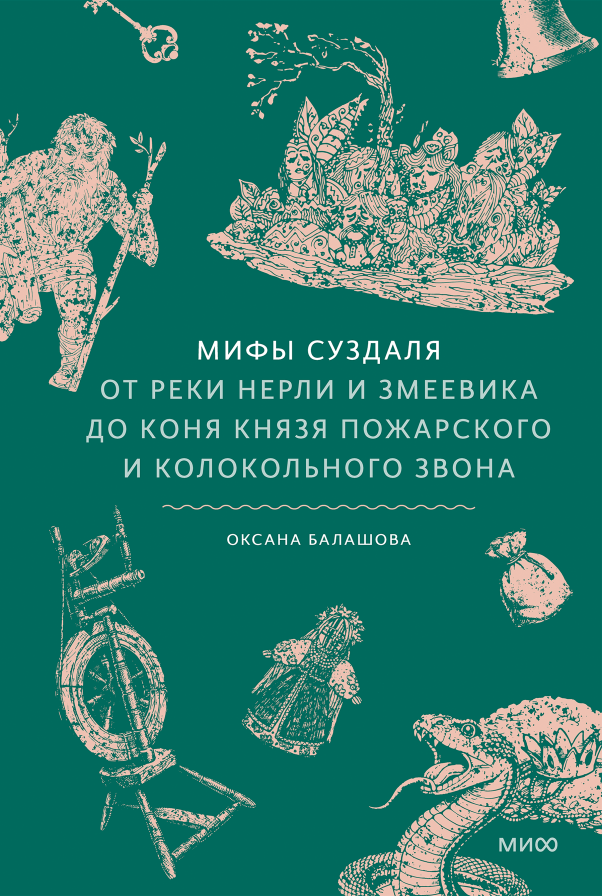
"Myths of Suzdal. From the Nerl River and the serpentine to Prince Pozharsky's horse and the bell ring"
Moscow: MIF, 2026. 224 p.
The stories passed down from generation to generation by the inhabitants of Suzdal and its environs help to bring even the most ancient mythological plots to life and bring them closer to modernity, whether it be the tragic death of the first Russian saints Boris and Gleb (whose 12th-century temple adorns the village of Kideksha next to Suzdal) or the wonderful legend of how the Virgin Mary, saving the Pokrovsky Monastery She helped Saint Sophia of Suzdal and the nuns to weave an invisible veil overnight, turning the long spires from the elongated domes of neighboring churches into special needles.
This legend is described in the final, third part of the book — "Folk Hagiography of the Suzdal Opole", the heroes of which are the most significant locally venerated saints. In addition to Boris and Gleb, these are Sofia of Suzdal (she is also Solomonia Saburova, the first wife of the Grand Duke of Moscow Vasily III Ivanovich, imprisoned in the Pokrovsky Monastery in Suzdal in 1525), Euphrosyne of Suzdal and Euphemia of Suzdal. The antiheroes in the chapter "Punishment for blasphemy" are those who dared to raise their hands against Christian shrines (temple, icon, church utensils), as well as desecrators of springs, wells and mysterious reservoirs, such as the small lake Omut: "Once a woman, tending her two sheep, took off a dirty handkerchief from her head and washed He's in the lake. And the next day, her hands went numb."

Despite the abundance of breathtaking stories set in the Suzdal Region, the author notes in his introductory remarks that for some reason this region has always been of little interest to folklorists, unlike the neighboring regions (Novgorod, Kostroma, Ryazan, Ivanovo, Murom), but it attracted the close attention of archaeologists. Balashova pays attention to their finds in the first part, "On Spirits and Fears," starting with ancient Suzdal amulets discovered during the study of one of the most famous and studied Upper Paleolithic sites in Eastern Europe, Sungir, located on the eastern outskirts of Vladimir. Among the amulet charms typical of the Suzdal pre-Mongol and post—Mongol history, the author of the book highlights noisy jewelry - sets of pendants with several multifunctional figures that not only protected the owner, but also carried information about him: "Miniature spoons, combs, hatchets, keys, bells, knives, as well as zoo and ornithomorphic images they had a well-defined purpose and were associated with a specific area of benevolent and protective magic: personal well-being, the integrity of the family hearth, good health, successful hunting, military valor, etc."

From the very beginning, the folklorist intersperses ethnographic and socio-cultural discussions about the symbols and functions of amulets with fascinating stories from his personal archive recorded by participants of expeditions to the Suzdal region in the period from 1990 to 2001 and from 2021 to 2025. Grave graves Many of them are published in the book for the first time, for example, a scary story about how one woman decided to visit her mother's grave on an "unauthorized" day (and all days "not related to any planned funerals or reasons regulated by Christian tradition for visiting the graves of deceased relatives" were considered unauthorized for going to the cemetery).. However, in case of an irresistible desire to visit the dear deceased on a "bad" day, Suzdal residents had ways to avoid negative consequences — rattling keys, the ringing of which scares away the dead, was considered the most effective. "I went [to the cemetery] before noon, at 11 o'clock," the informant tells the folklorist. — I sat down at the grave, I said, "Mom, I've come to you...", and then something shur-shur, shur-shur. How someone turns over. I got scared, I pulled out the keys, and like bells, ding-ding-ding, ding-ding-ding... yes... I'm shaking my keys, and I'm shaking all over with fear. And you can't scream in a cemetery... The women told me afterwards: "If you hadn't had the keys, the dead man would have taken you away."
But some historical figures appear completely alive in the second part of the book, which deals with historical and toponymic Suzdal legends. Balashova prefaces this part by clarifying that, of course, the oral historical traditions collected by folklorists are "not direct facts of history, but conjectures, rumors, and rumors that have been poetized by the popular consciousness," but at the same time they are not without foundation in the form of the most reliable events of the past. Moreover, these "speculations and rumors" can serve as a kind of socio-psychological cross-section.: "Behind each such folklore evidence there is a specific person who takes a very philosophical approach to the problem of existence in the Christian world (and indeed the Christian world itself) or to the question of the role of personality in history."

The most striking historical figure in this part of the book is Peter the Great, who, according to historical science, has never been to Suzdal. However, the local folklore tradition holds traditions that contradict this fact. The reason for this, as Balashova suggests, was real historical events, in particular, the "Suzdal search" of the early 18th century, when like—minded people of the oppositional Tsarevich Alexei were actively sought in Suzdal (his mother, another former royal wife, Evdokia Lopukhina, was exiled to the Pokrovsky Monastery). Along with this fact, the legends about Peter's visit to Suzdal were mixed with the cultivation of famous Suzdal cucumbers.
This contamination of two seemingly unrelated circumstances leads Balashova to theoretical considerations about the general principles of folklore thinking: "... although Suzdal became the cucumber capital practically in the 19th and 20th centuries, in folklore, the confusion of different inexplicable events is associated with an attempt to explain them due to the same manifestation of actions and behavior characteristic of the folklore hero. On this side, the creative principles of the imagination of the Suzdal performers once again confirm the laws by which the folklore work is built."

Patriotic everyday anecdotes illustrate the behavior characteristic of the folklore Peter, in which the tsar, having tasted the Suzdal cucumber, becomes the guarantor of their highest quality. So, according to one version, "Peter arrives in Suzdal with his assistant Menshikov and a certain German (not with Lefort?) to "do an inspection" in male monasteries. Peter liked the cucumbers, and he praised the resourceful monks: "Oh, devils, delicious!" Liked the cucumbers, and Menshikov, who always accompanied his sovereign, ordered to prepare a "parcel for a long journey." But the German got sick. This is understandable: Menshikov is an associate of the tsar, but he is a Russian, and the German is still a stranger."
The gastronomic preferences of another historical figure and at the same time a popular folklore character associated with Suzdal, the great commander Alexander Vasilyevich Suvorov, are reflected in the legend of how Suvorov, upon leaving the village of Kistysh, ordered him to bake a hundred local cheesecakes with cottage cheese to treat "every soldier and his generals." Suvorov is generally characterized in Suzdal folk mythology from the best side: "Individual episodes associated with habits, an irreconcilable attitude towards idlers and drunkards, personal courage, bravery and quick reaction, have become favorite subjects of Suzdal legends about Suvorov." This, according to Balashova, is one of the manifestations of the "special attitude of former Suzdal residents to a strong personality," as proved by the folklorist cites the apt expression of Suzdal resident Fyodor Sergeevich Petukhov (born in 1923): "The Suzdal people see through — where a tear is water, where a rusty nail."
Переведено сервисом «Яндекс Переводчик»
