- Статьи
- Science and technology
- Borehole business: targeted drug delivery technology will be used for oil production

Borehole business: targeted drug delivery technology will be used for oil production

To increase oil recovery, scientists have borrowed technology from medicine. They suggested placing surfactants (surfactants) in silicon dioxide carriers, similar to how drugs are placed in capsules during targeted drug delivery. According to researchers, this principle can increase oil production by 10-15% in fields that have passed the peak of production and are at the stage of its decline, and increase the efficiency of existing reservoir development technologies. However, further tests are needed. Read more about the new technology in the Izvestia article.
Targeted delivery for oil production
As a result of the collaboration of petroleum engineers with specialists in targeted drug delivery at Skoltech, scientists have proposed new surfactants to increase oil recovery from wells, as well as an innovative way to increase the effectiveness of such reagents. The molecules of the active substance are placed in silicon dioxide carriers, a similar principle used in targeted drug delivery.
Surfactants are widely used to increase oil recovery, scientists told Izvestia. These reagents are pumped into the well as part of an aqueous solution and help to release oil by reducing the interfacial tension at the interface between water and oil, improving the wettability of the rock with water and — with additional gas injection — the appearance of foam, which increases the mobility of hydrocarbons. The work of researchers from Skoltech describes a way to improve these properties of existing reagents and suggests two new surfactants.

Carbonate Rock Sample/Carbonate rock
— We borrowed the very idea of encapsulation, enclosing the active substance in a shell, from medicine — it is new for oil production. Both surfactants studied in the work had not previously been studied in detail and had not been encapsulated. The medium—porous silicon dioxide particles forming the shell in our case also did not receive enough attention in the context of oil recovery enhancement methods: most of the work is focused on other delivery systems," Arseniy Chekalov, a graduate student at Skoltech in the Oil and Gas Business program, shared the details.

Scientists have shown a synergistic interaction between disintegrating capsules and the surfactants contained in them. In experiments with oil-bearing rock samples, new compositions have demonstrated properties that are valuable for improving oil recovery.

Firstly, they have a rather low coefficient of adsorption on the rock, which leads to a low consumption of reagent per gram of rock, which means that the same amount of reagent will penetrate deeper into the formation. Secondly, the reagents significantly reduce the interfacial tension at the interface between water and oil. Thirdly, the wettability of carbonate rocks with water is significantly improved, which allows it to better displace oil. Moreover, all three properties improved when the reagents were encapsulated in a silicon dioxide shell, the experts said.
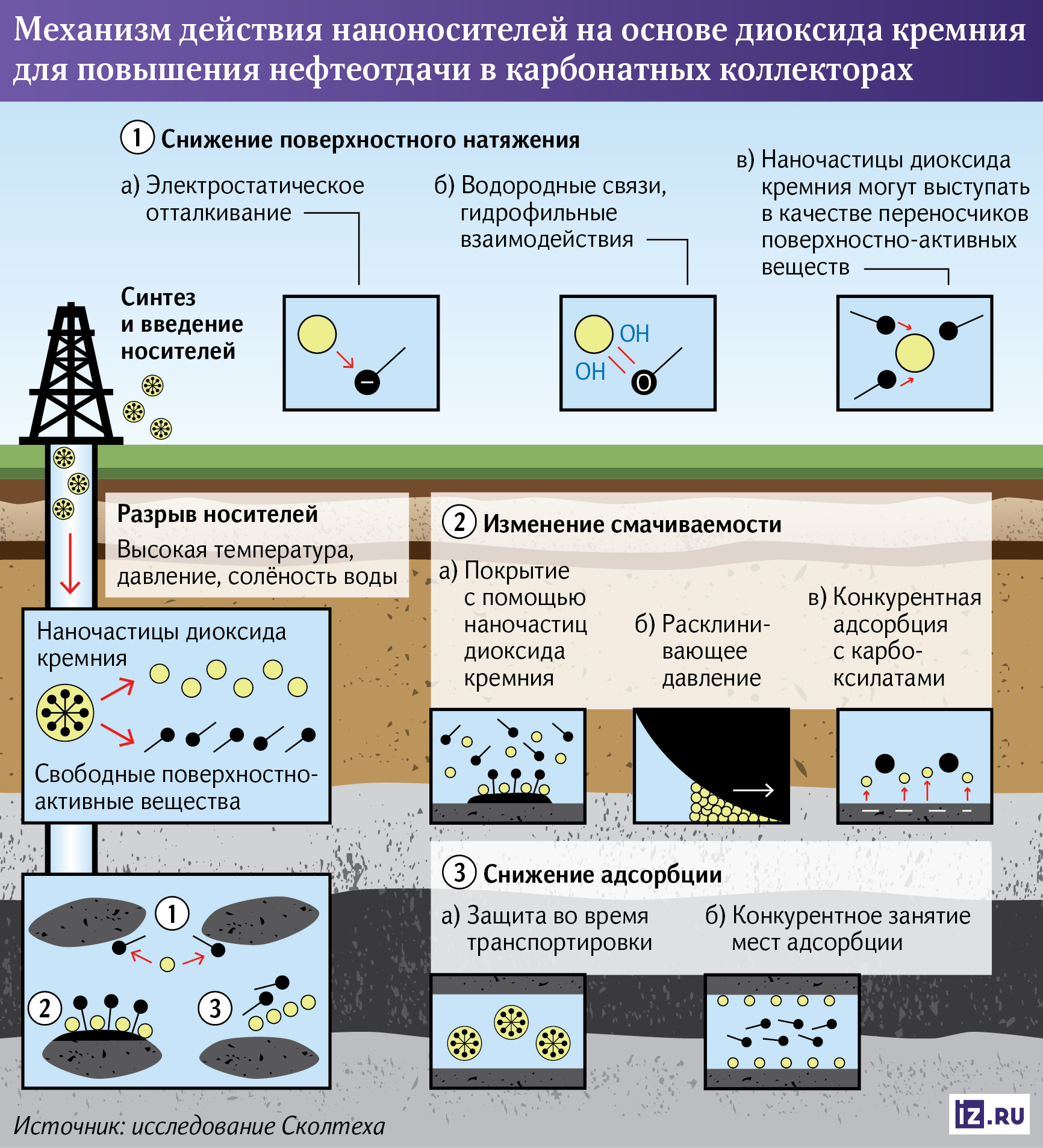
According to the scientists' wildest assumptions, using the new technique, the production level can be increased by 10-15%. The method can be applied in those fields where oil production is conducted. They are usually in the third or fourth stage of operation, which are characterized by falling production and high waterlogging. This means that most of the oil reserves that can be extracted naturally have already been exhausted and special technologies need to be used, Arseniy Chekalov told Izvestia.

Scientists propose similar methods to increase oil recovery in order to extract residual oil from the pores of the rock.
— We have obtained very promising results, which clearly showed that encapsulation can increase the efficiency of oil displacement due to synergistic interaction at the interface of phases. However, this work is only the first step," said Chengdong Yuan, head of the study and senior lecturer at the Skoltech Center for Science and Technology of Hydrocarbon Production.
The prospects of the methodology
Next, scientists need to evaluate encapsulated surfactant systems under dynamic flow conditions, as in the operation of a real reservoir, including in experiments with core flooding and controlled capsule destruction. Such tests will be needed in order to adapt the technology to different types of reservoirs and make it more flexible and reliable in terms of actual use in the fields.

Despite significant oil reserves in Russia and in the world, its resource is depleted. Scientists are thinking not only about alternatives to oil, but also about increasing oil recovery. This aspect is relevant for oil—producing enterprises around the world, Vladimir Pinaev, a member of the Public Council of the Basic Organization of the CIS Member States for Environmental Education, associate professor of the Department of Environmental Safety and Product Quality Management at the Patrice Lumumba Institute of Ecology of the RUDN University, told Izvestia.

— Surfactants are quite popular as substances that promote better oil recovery. Using a wrapper (encapsulation method), the authors propose to achieve targeted delivery. At the same time, the issue of actual delivery to a specific location, observation and destruction of the capsule in reservoir conditions remains difficult," the expert noted.

It is difficult to judge how effective the implementation of the method in the oil industry will be at the moment — experiments with oil from different fields are needed, after which it will be possible to talk about efficiency in advance, said Professor of the Department of Development and Operation of Oil Fields at Gubkin Russian State University of Oil and Gas (NIU), Professor of the Department of Environmentally Friendly Technologies. Alexander Drozdov, member of the editorial boards of the journals "Oil Industry", "Territory of NEFTEGAZ", "Drilling and Oil", RUDN University Institute of Ecology.
— It is important to remember that the introduction of any additional substance into the environment should be carried out with extreme caution, — said the specialist.
According to him, following the presumption of environmental danger of any activity, it is necessary to pay attention to the maximum permissible concentrations (MPC) of the proposed substances, if they are established. If not installed, install it before the start of field testing.

"In addition to the laboratory stage, field tests of the proposed technologies are needed both in the Far North and in the southern mining regions," said Tatiana Ledashcheva, associate professor at the Department of Environmental Safety and Product Quality Management at the Patrice Lumumba Institute of Ecology at the RUDN University, member of the editorial board of the online scientific journal Waste and Resources.
The study is published in the journal Advances in Geo-Energy Research.
Переведено сервисом «Яндекс Переводчик»
