
Day of Wrath: how war criminals were tried in Kiev

On January 28, 1946, the Kiev Military District Tribunal sentenced former soldiers of the German army and SS and SD officers who carried out an occupation policy in Soviet Ukraine during the Great Patriotic War. From the materials of this trial, the world learned a lot about the monstrous atrocities of the Nazis in the occupied territory of the Soviet Union. Izvestia recalled the details.
"For the German Fascist villains"
Already in the first year of the Great Patriotic War, the Soviet justice system was developing approaches to investigating Hitlerite war crimes that had never been seen before. The decree of the Presidium of the Supreme Soviet "On punishments for the Nazi villains responsible for the murders and tortures of the Soviet civilian population and captured Red Army soldiers, for spies, traitors to the Motherland from among Soviet citizens and for their accomplices", issued in April 1943, became a milestone. For the first time in the history of the USSR, punishments such as hanging and hard labor were introduced, which indicated the enormity of the Nazis' crimes. The Extraordinary State Commission for the Identification and Investigation of the Atrocities of the Nazi Invaders and Their Accomplices and the Damage They caused to citizens, collective farms, public organizations, state Enterprises and Institutions of the USSR (CHGK), established in November 1942, was engaged in collecting information about the atrocities of the invaders. The first trials of fascist criminals took place during the war years in Kharkov (in December 1943) and in Krasnodar (in July 1943).

Soviet troops are passing through Khreshchatyk. November 1943
After the war, preparations began for a thorough tribunal against the Nazis, who pursued a punitive policy in occupied Soviet Ukraine. The CHGC identified the main war criminals who were to be brought to justice at this trial. Fifteen of them ended up in the dock in January 1946, at a trial that opened on January 17 at the Kiev District House of Officers.
Correspondents from Izvestia and Pravda worked on the trial, thanks to whom the country learned about how justice was being done.

"The installation of mass destruction"
The prosecution collected convincing evidence confirming the guilt of the German occupiers in war crimes.
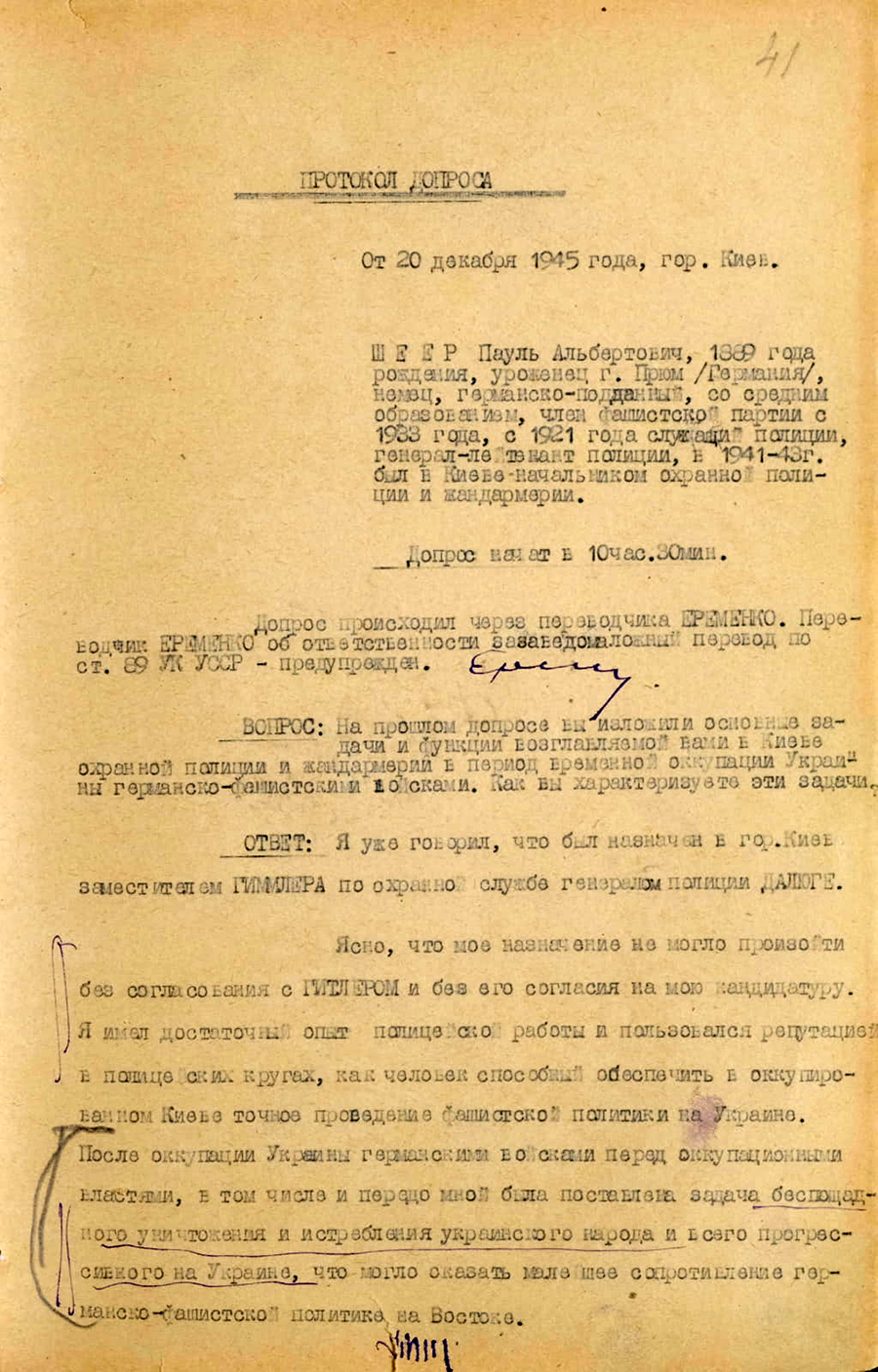
The main figure among the accused was SS Gruppenfuhrer, head of the security police and gendarmerie of the Kiev and Poltava regions, Paul Scheer. He personally gave the German punishers the right to shoot every Soviet person on the streets of occupied cities after dark. "We received instructions about the mass extermination of the Soviet population in the occupied territory from the leaders of the German punitive authorities in Ukraine at a meeting in June 1942 from Heinrich Himmler," Scheer told the court.
SS Obersturmbannfuhrer Georg Heinisch, who operated in Melitopol, was outspoken: "We were clearly told that after the German army manages to capture Ukraine, the German population will settle there. Special honor will be given to those who took part in the campaign against the Soviet Union. I was asked to look for a large estate in the Melitopol region, which will forever remain mine." This executioner participated in the executions of five thousand people. In addition, Heinisch issued an order to close all schools in the Melitopol district and introduced compulsory labor for schoolchildren. Why should subhumans learn? He organized the extermination of three thousand children, whose only fault was that they were born from interethnic marriages. At the trial, Heinisch tried to shift the blame for this action onto the command. But there was accurate evidence that he carried out the monstrous order with enthusiasm.
Chief Lieutenant Emil Iogshat, commander of a field gendarmerie platoon, personally shot civilians in Artemovsk. He was not going to shift the blame to the political leadership: too much testified to his personal contribution to the punitive policy of the Third Reich in Ukraine.

The defendants at the Kiev trial. In the front row: Karl Burckhardt, Georg Truknenbrod, Paul Scheer, Georg Heinisch and others
"I find it difficult to say how many Soviet people were shot and hanged in Donbass, since I did not keep records, but I believed that the more Soviet citizens were killed, the easier it would be for us Germans to pursue our colonial policy," said SS Gruppenfuhrer Karl Burckhardt, commander of the 6th Army's rear area in the territory. The Stalinist and Dnepropetrovsk regions. By his order, the bodies of 75,000 martyrs were dumped into the N4-bis mine in Stalino (now Donetsk).
One of those who appeared before the court was technically a military man. Fritz Beckenhoff was the agricultural commissar of the Borodyansky district of the Kiev region during the occupation. This civilian fanatic personally killed local residents. The case file contains testimony about how Beckenhoff arrested three people in one village, took them to the forest and shot them.

Sending Soviet citizens from the occupied territories to forced labor in Germany. The year 1942
...When the Red Army was advancing and it became clear that sooner or later the Germans would lose Kiev, they began with renewed vigor to drive the inhabitants of the city to Germany. This is evidenced, for example, by such a dialogue between the prosecutor and Scheer at the hearing.:
"Prosecutor: How many civilians of Kiev were abducted to Germany?
Scheer: As far as I know, there are about 142,000 people.
Prosecutor: Did people go voluntarily or did you have to apply repressive measures to them?
Scheer: No one went voluntarily. We raided the streets, the cinema, the bazaars."
Scheer spoke frankly. He looked dejected. He understood that his case was lost, there was no chance of escape.
Lieutenant Colonel Georg Trukenbrod, the military commander of Pervomaisk, Korostyshev and Korosten, was the only one of the defendants who pleaded not guilty. But his guilt was proved irrefutably.

Not subject to appeal
The verdict was announced on January 28, 1946, by Major General of Justice Terenty Sytenko. According to the testimony of criminals and witnesses, according to the documents analyzed by the judges, more than four million Soviet citizens were exterminated on the territory of Ukraine during the years of the German occupation. The number of people abducted to Germany exceeded two million, many of whom died of starvation and overwork. The occupiers burned, destroyed and looted thousands of cultural institutions, destroyed 647,000 residential buildings, stole 2.8 million horses, more than 7 million cattle and about 15 million small cattle to Germany. "The Germans took away things and food from the peasants, and for failure to fulfill the unbearable demands, the peasants were shot and imprisoned in concentration camps and burned to the ground entire villages," the verdict said.

City workers on the square during the execution of the verdict of the military tribunal. January 29, 1946
12 of the 15 defendants were sentenced to death by hanging, and three executioners, who were considered perpetrators but not initiators of the crimes, received 15 to 20 years of hard labor. The verdict was not subject to appeal.
On January 29, an execution took place on a wooden scaffold in the center of Kiev on Kalinin Square (now Independence Square, the very "Maidan"). The German generals probably realized long ago that their fate was sealed, that they would not be able to save their lives. But, according to eyewitnesses, they were shaking at the last parade.

Execution of convicts. January 29, 1946
"The numerous workers present at Khreshchatyk greeted the execution of the sentence with universal approval," Izvestia wrote the next day.
The Kiev trial took place simultaneously with the regular hearings in Nuremberg. Soviet lawyers have shown Europe an example of convincing, professional work. The Soviet justice machine worked smoothly, exposing war criminals who were not only tools in the hands of Hitler and his associates, but also took the initiative during punitive actions. The process corresponded to the norms of international law, and therefore remained in the history of justice and in the annals of the Second World War.
The author is the deputy editor—in-chief of the magazine "Historian"
Переведено сервисом «Яндекс Переводчик»
