Give a "Collection": the new museum will show art on a grand scale


Walls made of oxidizing copper and escalators with graffiti by contemporary artists and 13 thousand square meters. All this is about the new museum "Collection", which will open on December 2 in the area of the former industrial zone ZIL. The institute was headed by heavyweights of the Russian art scene: Alexander Borovsky, head of the department of the latest trends at the Russian Museum, and Irina Tolpina, ex-director of the Moscow Manege. Among the first exhibitions, they promise a large-scale panorama of African art. Izvestia was among the first to visit the newly built building and assessed the prospects of the high-profile project.
Ten years from idea to implementation
The idea of creating a large museum in the Zilart complex under construction has been discussed since 2015. At that time, the project was under the wing of the State Hermitage Museum — it was planned that it would become nothing less than its Moscow branch, but focused solely on contemporary art. The architect was chosen by the American Hani Rashid, who proposed to make a constructivist building with an allusion to the futuristic three-dimensional suprematism of El Lissitzky.
The deadlines were constantly shifting. In 2021, Rashid was replaced by the Russian Speech Bureau and Sergey Choban. Well, in 2023, Mikhail Piotrovsky said that "now such big projects are unrealistic." Nevertheless, even without the Hermitage's high-profile brand and conceptual support, the business did not stall. On the contrary, it has gained a new momentum. Alexander Borovsky from the Russian Museum became its artistic director (although this is positioned not as a collaboration with a state institution, but as his outside work), Irina Tolpina, who had previously headed Manege for ten years, took over the directorship.

But it seems that all the twists and turns are over now. The opening date has been set (the museum will be open to the public on December 2), but the building with an impressive area of 13 thousand square meters can already be appreciated. As well as the general concept. The name of the museum is "Collection". This is, of course, an allusion to the founders, famous collectors Andrei and Elizabeth Molchanov. However, it would be a mistake to think that the building would be completely devoted to their collection. The idea here is not just to show what is in the bins, but to create full—fledged exhibition projects, including from scratch by the artists themselves.
Africa in Moscow
This is exactly the kind of exhibition that viewers will see this winter. On the top floor there will be an installation by Grisha Bruskin, which the famous artist is developing specifically for the "Collection". Dies Illa is based on the project "Change of Scenery", shown in 2017 as part of the Venice Biennale. The Russian Pavilion, however, provided a relatively small space. And already in 2022, Bruskin returned to this image as part of his personal retrospective at the Tretyakov Gallery. Now we will see the third iteration, which promises to be the largest. It is not for nothing that the hall with the highest ceilings is allocated for it — up to seven meters.
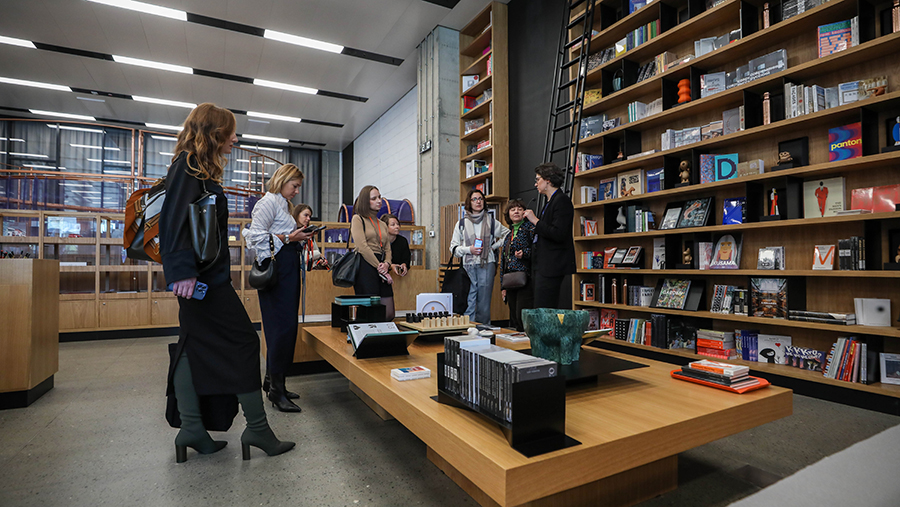
The other floors of the museum will house exhibitions "The Art of Africa: gods, ancestors, life", which brought together more than a thousand objects from the private collection of St. Petersburg artists Mikhail and Leonid Zvyagin (there is also a collection here!), and "Step off the pedestal: Sculpture in real space", dedicated to St. Petersburg sculpture of the second half of the 20th century. As we can see, the "divorce" from the Hermitage did not reduce the share of the art of the northern capital in the plans of the new institution.
Copper and graffiti
However, we still cannot judge how convincing this turned out to be. But it's quite possible to evaluate the building. It is located on Vesnin Brothers Avenue, the central street of Zilarta, and has the shape of a cube. Part of it is occupied by a huge atrium: an entrance area, a place for presentations and openings. Due to the absence of ceilings and giant panoramic windows in the floor, it feels like you're still on the boulevard.
Graffiti on the escalators accentuate the street atmosphere. It also looks impressive because not only the side panels are painted, but also the lower ones under the steps. In addition, the contrast between images works great. Dmitry Aske's original "mosaic" primitivism, Andrei Berger's abstract organic patterns, Alexey Luka's ironic quasi-suprematist compositions, and Maxim Im's voluminous "writings" seem to represent completely different artistic worlds, but the resulting eclecticism of street art as a genre (obviously as free and informal as possible) turns out to be very becoming.
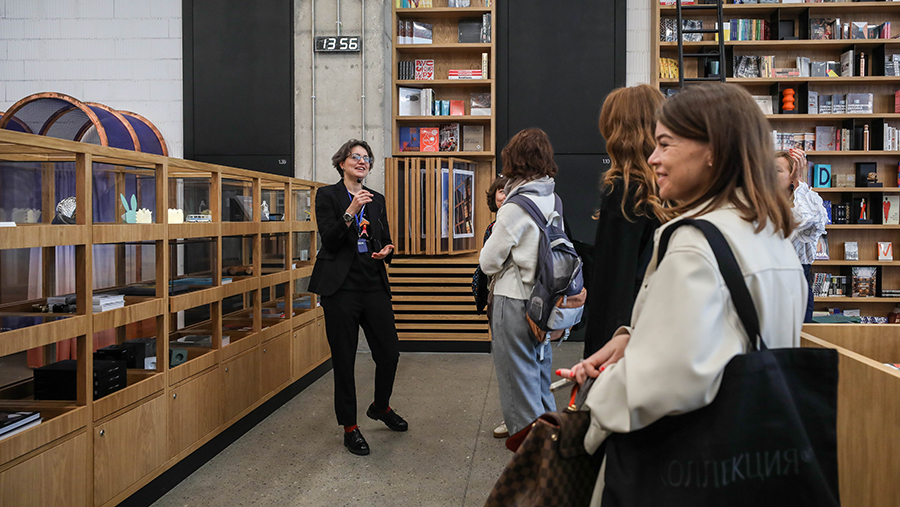
In general, the architectural solution of the "Collection" pleases with its boldness. There is no lifeless coldness of urbanism and the alien perfection of some Moscow City skyscrapers. Another bold decision, along with graffiti, by the creators of the project is to decorate most of the interior surfaces with copper blocks. Moreover, this copper has not been treated from oxidation, so even before the opening of the museum, many panels were covered with a dark green patina, and in some places the handprints of the builders are completely visible.
The point is this: the building should live like a person and art, and change its appearance over time. In a sense, it is also a global art experiment, a non-stop performance: no one knows exactly what the interiors will look like in five, ten, 15 years. How many spots, blackening and other traces of time will appear there. And even the museum staff is not able to control this process.
Dump truck for art
The exhibition halls themselves are another matter. Everything there is entirely in the hands of curators and artists. Each of the four halls (totaling over 5,000 square meters!) It can be divided into several independent zones. Thus, more than a dozen exhibitions can be held simultaneously. Inside, the walls are concrete, and the architects of the expositions are given complete freedom of action. The light, climate, and materials make it possible to exhibit any art and make almost any temporary building. But most importantly, the spaces can accommodate even very large installations that would simply be impossible in many other Russian museums.
This scale stands in funny contrast to the first sculpture, which has already been exhibited by the "Collection" — though not inside, but outside the building. Vim Delvois Dump Truck is a dump truck made of pseudo—gothic panels. Every element of it, whether it's a wheel or a driver's cabin, resembles the stained glass windows of Catholic cathedrals. And what is the meaning of such a strange combination is not very clear. Although the fact that it attracts attention and is remembered is indisputable. However, the sculpture as a whole is relatively small. Perhaps even smaller than a real dump truck. And next to the giant cube, the museum looks almost like a toy.
But the creators of the institution promise that Dump Truck is just the beginning, and the space around the building will grow with other objects more appropriate to its scope. Well, his swing.
Переведено сервисом «Яндекс Переводчик»
