Precious resource: diamond nanofluid will help create eco-friendly heating systems
- Статьи
- Science and technology
- Precious resource: diamond nanofluid will help create eco-friendly heating systems


Russian scientists have developed a diamond nanofluid that converts solar energy into heat. As a basis, the authors took water with particles of crushed graphite, exposed it to a powerful ultrasonic pulse and microwave radiation, and turned graphite into nanodiamonds ten times smaller than viruses. Then they created a miniature solar collector, a device for heating water using light energy. With this nanofluid, it has demonstrated a record 87% efficiency. The development will make it possible to improve and reduce the cost of environmentally friendly heating systems, experts told Izvestia.
How to turn graphite into diamonds
Scientists from the National Research University "Moscow Power Engineering Institute" (MEI) have tested a diamond nanofluid, which was synthesized and patented by specialists from NPC Nanosystems LLC (Rostov-on-Don). As the scientists told Izvestia, they used water with particles of crushed graphite as the basis for the nanofluid. She was affected by powerful ultrasonic pulses and microwave radiation, which caused microscopic bubbles to form in the water. Their collapse locally increased the water temperature to 5,000 °C, and the pressure to a thousand atmospheres. Under these conditions, graphite turned into nanodiamonds ten times smaller than viruses.
Using this method, the authors prepared nanofluids with different concentrations of diamond particles — from 0.01% to 0.55%. The researchers then placed the resulting samples in an experimental setup with a lamp that mimics sunlight in spectrum, and tested how quickly the liquids heat up.
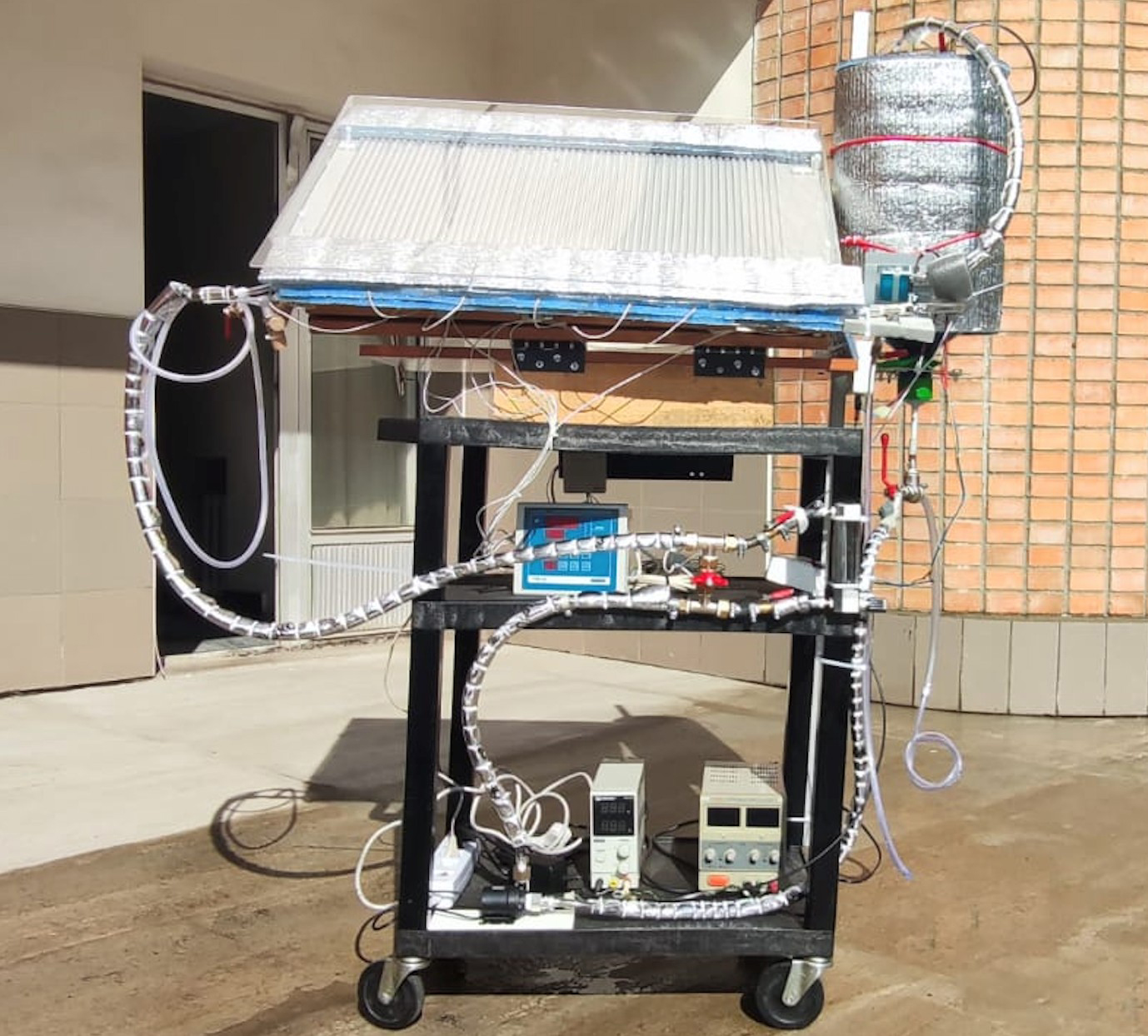
The experiment showed that a liquid with a concentration of 0.1% diamond nanoparticles converts sunlight energy into heat with an efficiency of 75.8%. The sample with a nanoparticle content of 0.25% showed the best result — its efficiency reached 87.2%. This value exceeds the characteristics of similar collectors based on distilled water and a traditional solid-state device by 40.7% and 14.5%, respectively.
— Our development will help to increase the efficiency of solar thermal installations and other energy-efficient systems. It allows you to convert sunlight into heat faster and more completely than analogues, which means obtaining large volumes of hot water and heat at a lower cost. This technology is especially useful for homes, businesses, and entire villages in remote areas where access to centralized energy sources is limited or unavailable. The implementation of this development will help make solar energy more accessible, reduce dependence on oil and gas, and reduce greenhouse gas emissions," a leading researcher at the Hydrodynamics and Heat Transfer during Evaporation, Boiling and Condensation of Working Fluids on the surface of Hybrid graphene Composites told Izvestia in relation to promising areas of traditional and alternative energy." NRU "MEI" Inna Mikhailova.
This is a step towards cleaner air, stable energy prices and greater energy independence, the expert emphasized. In the future, such solutions may change the approach to providing heat and energy to cities and rural areas around the world, she added.
Traditionally, heating and hot water supply systems use electric energy, gas, or solid materials such as coal and pellets (compressed wood waste) to heat water as fuel. However, solar energy can serve as a more environmentally friendly alternative. For its conversion, collectors are used in which solid carriers, such as semiconductor crystals, absorb light and transfer its energy to thermally conductive systems. But such devices are imperfect: they lose some of their energy due to inefficient absorption and heat transfer.
How does diamond nanofluid affect living organisms
Scientists are developing solar collectors in which a nanofluid is a working element — a solution with particles that absorb and conduct heat well. However, most of the existing such liquids are either expensive to produce or insufficiently stable, experts said.
The replacement of traditional fuels, including oil, gas and coal, with renewable resources, such as wind energy and sunlight, has been of interest to scientists for a long time, Tatyana Ledashcheva, associate professor at the Department of Environmental Safety and Product Quality Management at the Patrice Lumumba Institute of Ecology at the RUDN University, told Izvestia.
— An alternative version of the solar collector is proposed, in which the working element is a nanofluid — a solution with diamond nanoparticles (nanodiamonds) that absorb and conduct heat well. The lower cost of the presented sample compared to the analogues available on the market and its stability were noted. Of course, with mass production, this innovation can increase the efficiency of solar thermal installations and other energy—efficient systems in areas with sufficient solar radiation and contribute to improving the energy efficiency and environmental friendliness of the energy industry," the specialist said.
At the same time, Tatiana Ledvashcheva noted: There is no universal solution for all territories and conditions. So there are areas with different daylight hours and, consequently, solar radiation, and it is important to provide consumers on sunless days. It is also necessary to take into account the aspect of the device of energy storage and heat accumulators, their service life and further disposal.
The development of new technologies to increase the efficiency of such installations is an important process, said Vladimir Pinaev, member of the Public Council under the Ministry of Natural Resources and Environment of Russia, editor-in-chief of the scientific journal Waste and Resources.
— Attention should also be paid to the effect of diamond nanoparticles on living organisms when released into the environment. There are studies on the effect of diamond nanoparticles on living organisms. For example, in 2014, papers talk about the depressing effect of diamond nanoparticles on the development of zebrafish (Danio Rerio). More recent work, for example, on the effect of nanodiamond particles on luminous bacteria, has already mentioned a positive effect on them," the expert said.
Thus, additional research needs to be conducted before launching such devices into production. And to resolve the issue of recycling failed equipment and preventing spills, preventing liquids containing nanodiamonds from entering the environment, Vladimir Pinaev summarized.
The results of the study, supported by a grant from the Russian Science Foundation (RSF), are published in the journal Applied Thermal Engineering.
Переведено сервисом «Яндекс Переводчик»
