Magnet background: compact device will help detect brain and heart diseases more accurately by ECG and EEG
- Статьи
- Science and technology
- Magnet background: compact device will help detect brain and heart diseases more accurately by ECG and EEG

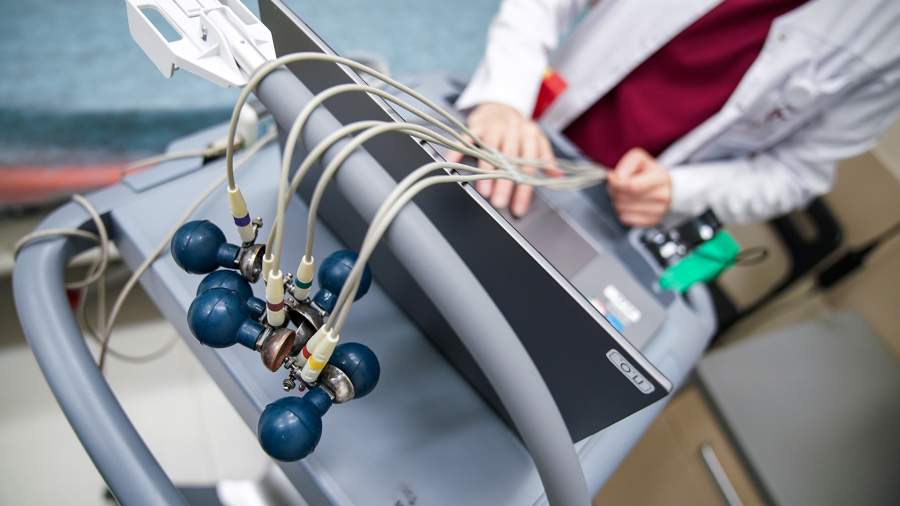
Russian scientists have created a miniature detector that registers magnetic radiation. Specialists have already started developing diagnostic devices based on it, which will be much more effective than the usual electrical methods of ECG and EEG. Magnetic devices for such studies already exist, but they are quite bulky and expensive, so they are still considered experimental. The new sensor will make them more compact and cheaper, after which they can be used in medical practice. But for this, it is necessary that the device is convenient and easy to use, experts say.
Registration of magnetic radiation using a microdetector
Specialists from MIPT and the V.A. Kotelnikov Institute of Radio Engineering and Electronics (IRE) of the Russian Academy of Sciences have developed a sensitive molecular-size detector capable of detecting magnetic radiation of different ranges. The invention can have many practical applications. One of the main applications in medicine is to create compact and cost-effective diagnostic devices for magnetic encephalography and cardiography. They are much more accurate than standard electroencephalography (EEG) and electrocardiography (ECG), but are still considered experimental, since the equipment for them can only work at ultra-low temperatures. For this reason, such devices are large and expensive. Scientists have already started work on creating equipment based on new principles.
— Human organs, such as the brain and heart muscle, generate electromagnetic impulses. But the power of the magnetic fields is very small. Our detector can register them and monitor the condition of these organs. ECG and EEG measure the electrical component of the heart and brain. But the magnetic component is much more accurate, due to the fact that it comes directly from these organs. Therefore, magnetic encephalographs and cardiographs are more effective. However, existing devices are too bulky for this, as they are installed in cryostats. And they are very expensive. We are creating sensors that operate at room temperature," said Sergey Nikitov, Head of the MIPT Department of Electronics and Director of the V.A. Kotelnikov Institute of Radio Engineering and Electronics of the Russian Academy of Sciences.

The new detector is slightly more than 100 nanometers thick. The main components of the device are a thin film of lutetium garnet and a layer of platinum. When microwaves hit a garnet, specific magnetization fluctuations occur inside it. They generate a spin current, which is transmitted to the platinum layer. Due to the special effect characteristic of platinum, this current is converted into an electrical voltage.
— We have not just reduced the microwave detector tenfold, but made it universal. The wide frequency range of the detector, its ultra—low power consumption and compatibility with silicon technologies in the future will help to create tiny and lightweight communication modules for space satellites, radars for drones, and, of course, elements for quantum electronics," added Sergey Nikitov.
Introduction of magnetic diagnostics
The advantages of magnetic encephalography and cardiography over their conventional electrical counterparts have been confirmed in many experimental studies. For example, an ECG does not provide a physician with enough data to detect a deadly coronary heart disease, but this is made possible by magnetic examination. And magnetoencephalography has successfully detected changes in the brain associated, for example, with multiple sclerosis, Alzheimer's disease and alcoholism. Currently, superconducting detectors, the so-called SQUIDs, are used to study magnetic fields. Their operation requires powerful cooling, and the sensor created at MIPT can replace them.
"There is only one device for magnetic encephalography in Moscow, and it is not included in clinical practice at all and is currently used exclusively for research purposes," Stanislav Stragnov, head of the Laboratory for the Analysis of public health indicators and digitalization of healthcare at MIPT, told Izvestia.
Magnetoencephalography (MEG), magnetocardiography (MCG) and the study of muscle activity magnetomyography (MMG) significantly exceed the accuracy of traditional EEG, ECG, EMG due to the simplicity of recording the magnetic field and independence from movement interference, explained Alexander Zakharov, Director of the Research Institute of Neuroscience of the SamSMU Ministry of Health of Russia.
— The practical demand for compact devices for these studies is very high. In neurology, MEG offers an unprecedented combination of high temporal and spatial resolution, allowing accurate tracking of neuron activity without distortion caused by the bones of the skull and the membranes of the brain. This opens up opportunities for early diagnosis of epilepsy, neurodegenerative diseases, as well as for accurate planning of neurosurgical operations," the expert said.

In cardiology, MCG provides a three-dimensional picture of the electrical activity of the heart with high sensitivity to ischemic changes and arrhythmias, which is especially valuable for patients with high cardiovascular risk. MMG has prospects in sports medicine and rehabilitation, as it will allow recording high-quality signals from muscles during movement and performing sports exercises, including in an aquatic environment, the expert added.
— The key advantage of portable systems is their potential accessibility. If modern MEG scanners occupy entire rooms and require millions of rubles for maintenance, then devices based on new sensors can be comparable in size to a headset of VR glasses and can be used even in a regular polyclinic. This will make it possible to introduce high—precision diagnostic methods into routine practice, including telemedicine and home monitoring," the doctor said.
However, to fully realize the potential, it will require solving related tasks — the development of a user-friendly interface, automatic signal processing algorithms and integration with digital medical platforms, he believes.
According to Maria Vedunova, director of the UNN Institute of Biology and Biomedicine, magnetic diagnostic methods are of interest to doctors, but so far their use is associated with errors. In addition, the new device must first be registered as a medical device and recommended by the Ministry of Health for use.
Переведено сервисом «Яндекс Переводчик»
