The question has long been: what will appear in place of the "Big Clay" near HPP-2


A sculpture by a Russian author may appear in place of the "Big Clay No. 4" at HPP-2, experts in the art industry believe. The dismantling of the controversial work by Swiss artist Urs Fischer, which appeared on Bolotnaya Embankment four years ago, began on Monday, July 28. The House of Culture has already announced the installation of a new facility, but what exactly is an intrigue. About which sculptures could claim the place of the "Big Clay" and what benefits, according to experts, it has brought in four years — in the material of Izvestia.
Why was the "Big Clay" needed
The dismantling of the sculpture "Bolshaya Glina No. 4" caused a stir in the information field, as did its installation on the walls of the HPP-2 art space in Moscow four years ago. At that time, the work of Swiss artist Urs Fischer, which had previously been exhibited in the squares of New York and Florence, was extremely ambiguously received by the metropolitan public. The 13-meter object — pieces of clay, kneaded by the author's hand, magnified many times and cast in aluminum — metaphorically referred to the fundamentals of art and creativity. But not all of them. Some awarded the sculpture with not the most flattering comparisons.
— Of course, at first the "Big Clay" caused a certain shock to the average citizen, but gradually it became a landmark object in Moscow. The fact is that people who visit museums of modern art have some preparation for the perception of such works. Namely, in an urban environment accessible to everyone, we have few such works. Therefore, the appearance of modern art outside is a very important step in shaping public opinion and interest in this phenomenon. It's not important whether someone likes this sculpture or not. Art was created in order to evoke emotions in people and not leave them indifferent. This object became recognizable and discussed, made us think and answer the question: what did the artist want to say," Maria Salina, director of the Latitude creative bureau, told Izvestia. Thanks to this experience, she believes, attitudes towards contemporary art are changing for the better.
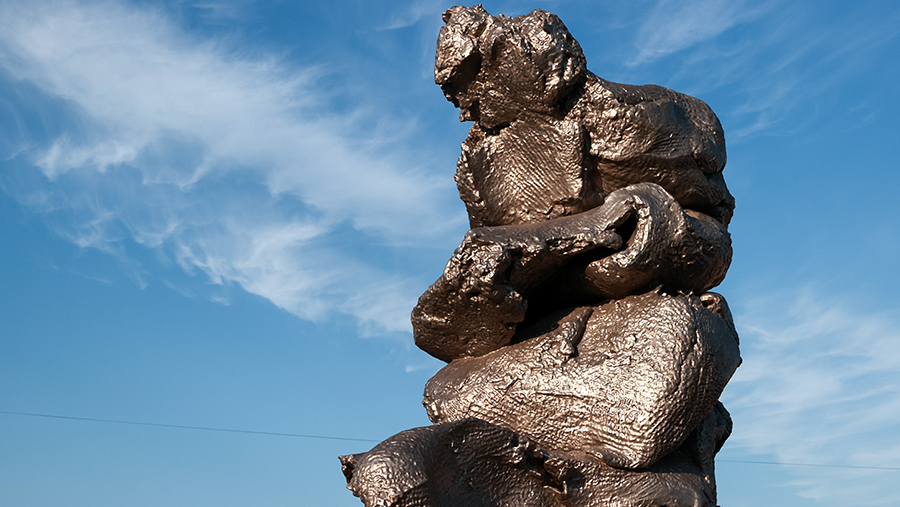
The artist Evgeny Ches, in turn, notes that such works can organically coexist in an urban space with the works of classics.
— This is an interesting art object, which is important - world—class. I would like to have a huge figure of Brian Donnelly (KAWS), for example, in Zaryadye. People would then take pictures of her against the background of the Kremlin. To make Jeff Koons's "Balloon Dog" appear, say, on Manezhnaya Square or in some art cluster. Damien Hirst's provocative work would look great in St. Petersburg. I want world artists to slowly fill the capital and beyond and introduce their work to a wide audience. "Big Clay" has caused a lot of discussion, because not all people are educated in the field of art," Evgeny Ches told Izvestia.
What will appear in place of the "Big Clay"
Bolshaya Glina will be replaced by another object as part of the planned rotation of works of art in the urban environment and the development of the territory adjacent to the House of Culture, according to the resources of HPP-2. Preparations have already begun, but what exactly will appear there is also a big intrigue.
— I don't think anything from the "Big Clay" series is waiting for us. The space is ready for a new artistic expression, and Muscovites, although they are used to Fischer's sculpture that has caused a public outcry, according to my observations, expect something more understandable. At the same time, the new work should correspond to the architectural context, which dictates the need for a significant size and vertical dominant, capable of "holding" the volume, as the "Big Clay" did, — says art critic Alexandra Pupsheva.
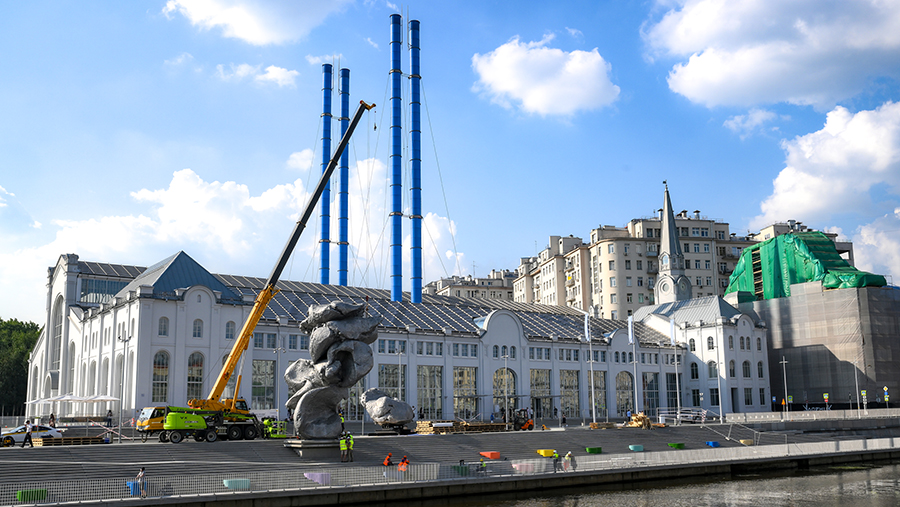
The delivery of large-scale work from abroad, the Izvestia interlocutor notes, is difficult and costly due to insurance, logistics and other nuances. Therefore, she assumes that a modular sculpture will appear in place of the "Big Clay", which will be convenient to mount on site.
— Due to the fact that 2025 has been declared the Year of Culture of Russia and China, one would assume that an installation by a Chinese author awaits us, but I am not inclined to this version. Perhaps HES-2 brought someone from the Middle East artists, as they are now easier to work with and transport. But the most logical thing, in my opinion, is to install the work of a domestic author of an international level or a strong young artist. I think these could be installations by Francisco Infante, which, as we have already seen, perfectly enter into dialogue with the space of HPP-2, or a sculpture by Ivan Gorshkov," the expert concluded.
Gallery owner Polina Askeri sees two ways — to support a Russian artist (for example, to select him through an open competition) or to find a strong foreign author from a "friendly" circle.
Russian Russian artists — If we talk about our authors, I would consider the Recycle group, which made the Russian Pavilion at the Venice Biennale, Yuri Leonidovich Cooper as one of the most famous and powerful artists of modern Russia, but well-known abroad, Vladimir Ivanov with his cute and close to Russian people images of a Kitten and Cheburashka, Pavel Bagan or Dmitry Kavargu, whose industrial facilities will ideally fit into the context of a hydroelectric power station. Among the foreign names, Huang Yulong (China), a resident of ASKERI GALLERY, is interesting — he is already well known to the Moscow public, and his sculptures have that universal aesthetic that works in any space. I also really love the work of Lorenzo Quinn, who talks to his audience about the most important things: love, loyalty, friendship and family," Polina Askeri told Izvestia.
In matters of cooperation with foreign partners, the gallery owner noted, in addition to difficulties with logistics and customs, there are now political risks, but art, she emphasizes, is a soft power, and its task is to build bridges between countries, cultures and peoples. The main thing, the expert believes, is for the new facility to become not just a replacement for the "Big Clay", but a vivid statement worthy of the legacy of HPP-2. However, it may not be clear to everyone, says Viktor Misiano, a Russian theorist and curator of contemporary art.
— Modern art as a whole remains far from the average ideas of an ordinary Russian citizen. We rarely see that it immediately wins the sympathy of a wide audience. So whatever the institution's decision, there remains the risk that the new facility will fall into counterpoint with some mass representations. There's nothing you can do. On the other hand, eventually, people should get used to the fact that there are areas in which they are incompetent," he told Izvestia.
The HPP-2 made a hint: it is reported that the new artistic work will be the answer to the question of what happens after the first creative impulse. Izvestia sent a request to the House of Culture, but no response had been received at the time of publication.
Переведено сервисом «Яндекс Переводчик»
