"We managed to win due to the technique of execution and artistic impression"

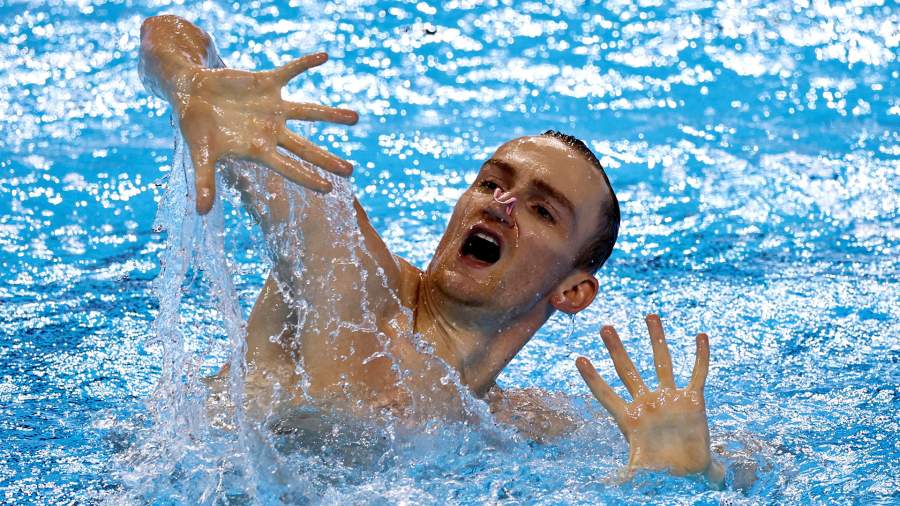
Alexander Maltsev brought the second gold medal to the Russian team of neutral athletes by winning the free solo program at the World Championships in Singapore. This time, the competition was, at least on paper, higher than in the technical program. In an interview with Izvestia and SE, Maltsev spoke about the preparation for the competition, the specifics of judging and other details of his victory.
— Did you feel like you were going to win today?
— After the technical program, as I have already said, the weight lifted off my shoulders, and I gained confidence. But yesterday at 11 p.m. I started to worry, because the starting protocols appeared, and we saw that the rivals had declared very high difficulty coefficients, and this also matters. Not always the one who does really well, cleanly, may be higher. Sometimes difficulty also plays a role, at least that's what happened in our competitions before. It was a little nervous. Thank God, it was the technique of performance and artistic impression that played a role today. We managed to win due to these criteria, despite the fact that the difficulty coefficient was lower. The competitors who stated the difficulty above did not pull the execution, that is, they nominally do the elements, but the quality of their execution is not the best.
— You've prepared this arbitrary one in two months.
- yes. This is a completely new program that we started putting on after the Russian Championship.
— Can we say that it was a risk? Two months before Singapore?
— Yes, because, to be honest, I didn't want to change the program and thought to keep the old one, just to refine it, but the coach insisted, offered music, and we started playing. The program was finalized literally until the last day, before leaving for Singapore.
— How many clean runs did you make before the World Cup?
— I think I had one clean one. We're perfectionists, we always see mistakes, and to say that everything is perfect is almost never the case. There was one run, as I say, more or less. I think the best performances were here, at the competitions.
— Could you complicate the program?
— It is possible, but the quality will suffer. Today we saw this, the Kazakhstani athlete claimed 54 points, but forgot one bunch, others who did 52, were already tired by the end and left the water to knee level, no higher. It's still not a very good performance. And we try to maintain a balance so that there is complexity and execution at the same level, from the beginning of the program to the end. Plus, there should be a lot of choreography, because the artistic impression in the free program is 50% of the score.
And just those who made some bundles, increasing the complexity at their expense, did not show the choreography, and they, due to the low artistic impression, the second grade, flew down. And so, in theory, you can make 60 difficulty points. Just a breath and the elements.
— Have your concerns about refereeing finally been dispelled?
— I haven't looked at the details yet, but overall, considering the result, I'm very happy. It's also nice that the judges wish us good luck and treat us with great respect before the start, when we cross paths.
— Now you have a complete collection of World Cup awards in men's synchronized swimming.
— It's nice that we managed to perform in solo programs at this championship. This is my first such World Cup, before that we missed all three where there was a men's solo.
— Can you call yourself the best synchronized swimmer in the world in history?
— No, I can't say that. Let the federations, fans, and athletes give the assessment. I think everyone has their own fans, it's not for me to say here.
— The issue of weight control is obviously in women's synchronized swimming, how are you doing with this?
— On the contrary, it is difficult for me to gain weight when there is preparation before the competition and the competition itself. I lose as much weight as possible during this period. That is, when we have a preparatory stage, there are no runs yet, I keep a normal weight, I try not to lose weight. As soon as the preparation for the starts begins, I lose weight immediately after training, in a few days. The girls weigh themselves and are happy that they have lost a little weight. Then I get up, they see the numbers and say they're going to kill me.
— A Spanish series about synchronized swimmers has just been released, which is quite "cranberry", but in the first episode the girl takes a hypoxia test. What's your record? How long can you not breathe underwater?
— The last time I measured it was when I was a teenager, it was three and a half minutes then, but now I don't know. But now we have a problem with the fact that the amount of time spent underwater during hybrids has increased, especially in technical programs, there is one mandatory huge bundle. I had about 40 seconds in a solo, and it's going to be the same in a duet. It's very hard, because you're not just holding your breath, you're working. Duets are even more difficult because you have to count there, meaning you not only hold your breath and do it, you also count and adjust to your partner. You need to hold the drawing so that if your partner swims, you have to swim after her or, conversely, swim away. It takes even more effort. It's much more difficult than just sitting and holding your breath.
— We know very little about the inner world of men's synchronized swimming. Do athletes communicate with each other, for example?
— Always a very friendly atmosphere. It was also when we performed before the break, we all supported each other. And now that we've returned, it also feels like everyone is being treated with great respect. There is no unhealthy competition.
— Today, the oldest girl in the Spanish band, they performed under the Backstreet Boys, said that there was a problem — their youth no longer knows this band, a generational gap. Do you feel something similar, considering that you are 10-14 years older than most of the participants?
— To be honest, I saw most of the athletes who compete here for the first time, because they appeared in the last three years while we were away. There are practically no more people I've performed with before. I haven't even met everyone yet. It is possible that yes, there are already other interests, age.
"They don't come up to you on their own?"
— Sometimes they are afraid, they hesitate to approach, then they gain the courage and ask if it is possible to take a photo.
— There are duets ahead.
— This is a different discipline, synchronicity is already playing a role there, an additional factor that was not present in solo. The feeling of a partner is very important, and you need to be one with him in order to show a good result. But there is a big plus that we have already completed two programs, so I will only prepare the remaining two in training, because initially I did four in training before the World Cup, then three after I finished the technical one. It's two o'clock now. It's easier both physically and emotionally.
Переведено сервисом «Яндекс Переводчик»
