- Статьи
- Science and technology
- Precise frame: the first printed laryngeal implant in Russia will accelerate the rehabilitation of cancer patients

Precise frame: the first printed laryngeal implant in Russia will accelerate the rehabilitation of cancer patients
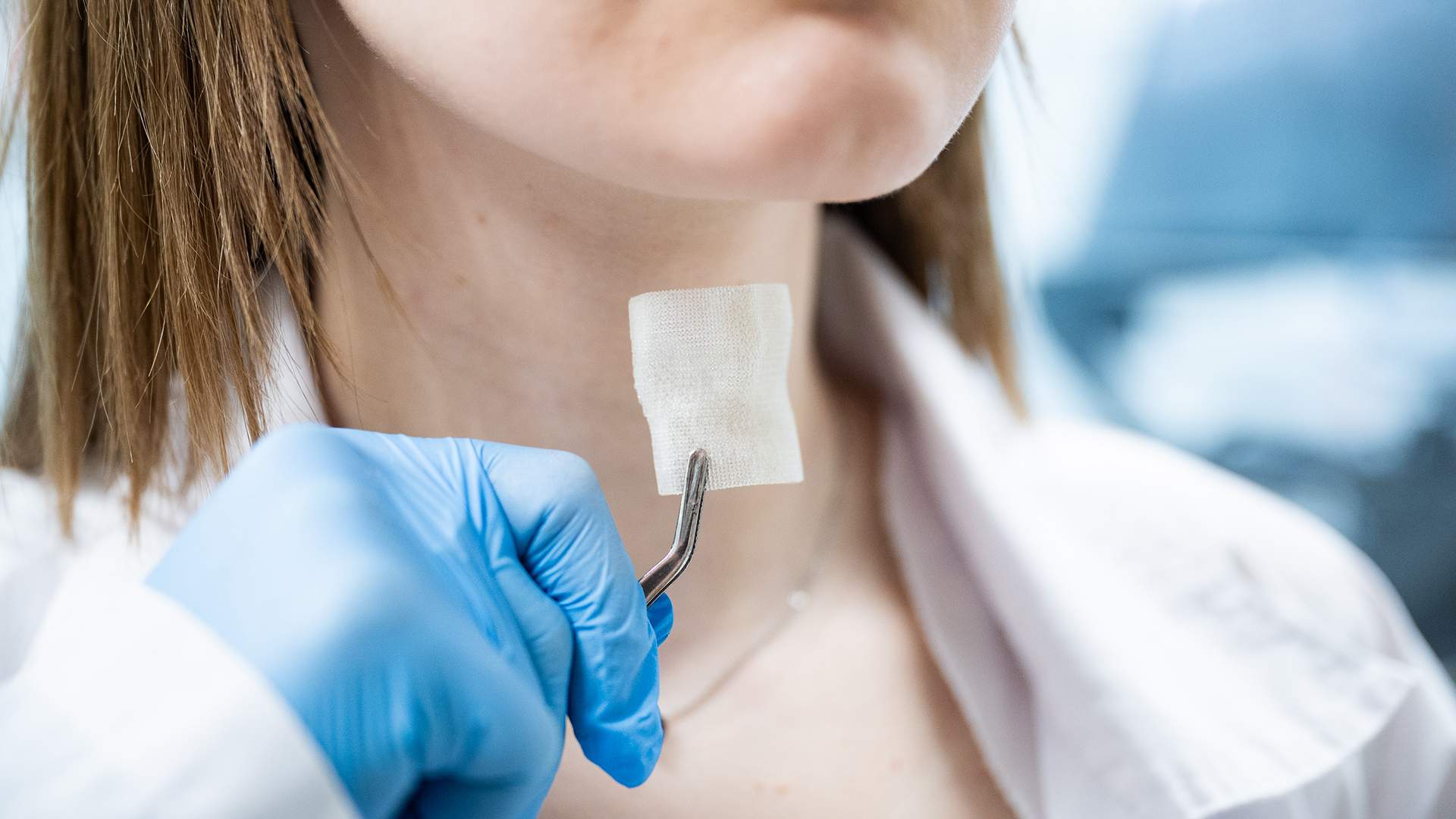
For the first time in our country, Russian scientists have developed a technology for the production of individual thyroid cartilage implants of the larynx. They are intended for patients who had to have this part of the body removed. This is most often the case with cancers of the head and neck. The implant in the form of a mesh, which takes into account the peculiarities of the patient's anatomy, serves as a framework for the body's own cells, which gradually build up on the structure. According to oncologists, laryngeal resection is very common in cancer patients. Her recovery requires complex surgical procedures, so any developments that can simplify this process are welcome.
The first domestic laryngeal implant
NUST MISIS specialists have developed a method for the production of individual thyroid cartilage implants of the larynx. They are printed on a 3D bioprinter, taking into account the anatomical features of the patient, in order to surgically replace the lost area of the throat. Scientists already have a prototype of the product. According to the creators, the proposed technology is economically feasible and allows for the mass production of a medical product.

Hyaline cartilage, which provides smooth sliding of the articular surfaces of the larynx, performs protective and supporting functions for neighboring organs, prevents the collapse of the respiratory tract, and muscles and ligaments are attached to it. However, in case of damage, it does not recover well, because there are no blood vessels in it, and the cells responsible for renewal cannot actively divide. Cancer patients often face this problem in the treatment of cancer, especially in the third or fourth stages, when the tumor grows into the larynx and the thyroid cartilage is removed. Laryngeal cancer is one of the most common cancers of the head and neck area. According to the data of the Russian Center for Information Technology and Epidemiological Research in the Field of Oncology at the P.A. Herzen Moscow Institute of Medical Sciences, the prevalence of laryngeal cancer in the country in 2022 was 28.7/100 thousand of the population.

The specialists suggested printing a thermoplastic polyurethane mesh with subsequent thermoforming for a specific patient. To allow cells to attach to the surface of the mesh, scientists suggest coating it with collagen or applying a biocompatible polyelectrolyte complex of chitosan and polyglutamic acid, widely used in regenerative medicine. The optimal porosity for surgical use was 50%.
— We obtained customized polyurethane cartilage skeletons using FDM printing and thermoforming based on CT data. Cytotoxicity tests have shown that the material is absolutely safe. We hope that with further implementation, the development will accelerate the rehabilitation of patients," says Elizaveta Peshkina, a graduate of the iPhD Biomaterial Science program at NUST MISIS.

The model assumes a promising industrial implementation within five to six years. At the same time, the technology can be adapted for other types of hyaline cartilage, for example, for nose reconstruction.
— Despite the acute clinical need, there are currently no commercially available implants for replacing thyroid cartilage defects suitable for mass clinical use. Bioprinting also allows you to restore native tissues, recreate complex anatomical shapes and scale tissue structures. Therefore, my colleagues and I from NUST MISIS have developed a technology for printing personalized implants that precisely repeat the shape of the damaged area," said Yusef Hesuani, Managing Partner of 3D Bioprinting Solutions, who participated in the development.

One of the most common operations for head and neck cancer
Igor Samoylenko, a senior researcher at the Blokhin Cancer Center, told Izvestia that loss of the larynx due to cancer is a really common problem and doctors are interested in new methods of organ restoration.
— Destruction of the laryngeal cartilage can be a problem, and some patients undergo its removal. After that, they try to restore it. Prosthetics are installed. There are different approaches to the use of implants. When it is installed as a biocompatible plastic frame for the patient's own cells, which provides mechanical strength and shape, there are good outcomes. A new inexpensive domestic implant will never be superfluous," said Igor Samoylenko.

According to Ruslan Alikhanov, associate professor of the Department of Surgical Diseases at the Faculty of Fundamental Medicine of Moscow State University, the restoration of the larynx after its resection in cancer patients requires very complex surgical interventions, so any new technique that can facilitate the work of a doctor will find its application.
— This approach may be promising, as there are many patients with head and neck cancer and with defects in the larynx area. They require complex procedures for resection and then for reconstruction. If there is some kind of laryngeal analogue that will help in reconstruction, then this will help in the work," Ruslan Alikhanov said.
Three-dimensional printing technologies have significant potential for creating customized solutions. They are already in demand and, as they improve, will be increasingly used for the tasks of reconstructive and plastic surgery. It is good if 3D-printed thyroid cartilage replacement implants become commercially available and, as a result, will be widely used in clinical practice, because the need for them will only increase. We are talking not only about patients with laryngeal cancer, but also about those who have been injured, Stanislav Stragnov, head of the Laboratory for the analysis of public health indicators and digitalization of healthcare at MIPT, told Izvestia.
Переведено сервисом «Яндекс Переводчик»
