- Статьи
- Society
- Everything is in sight: digital control over migrants will be strengthened in the capital

Everything is in sight: digital control over migrants will be strengthened in the capital
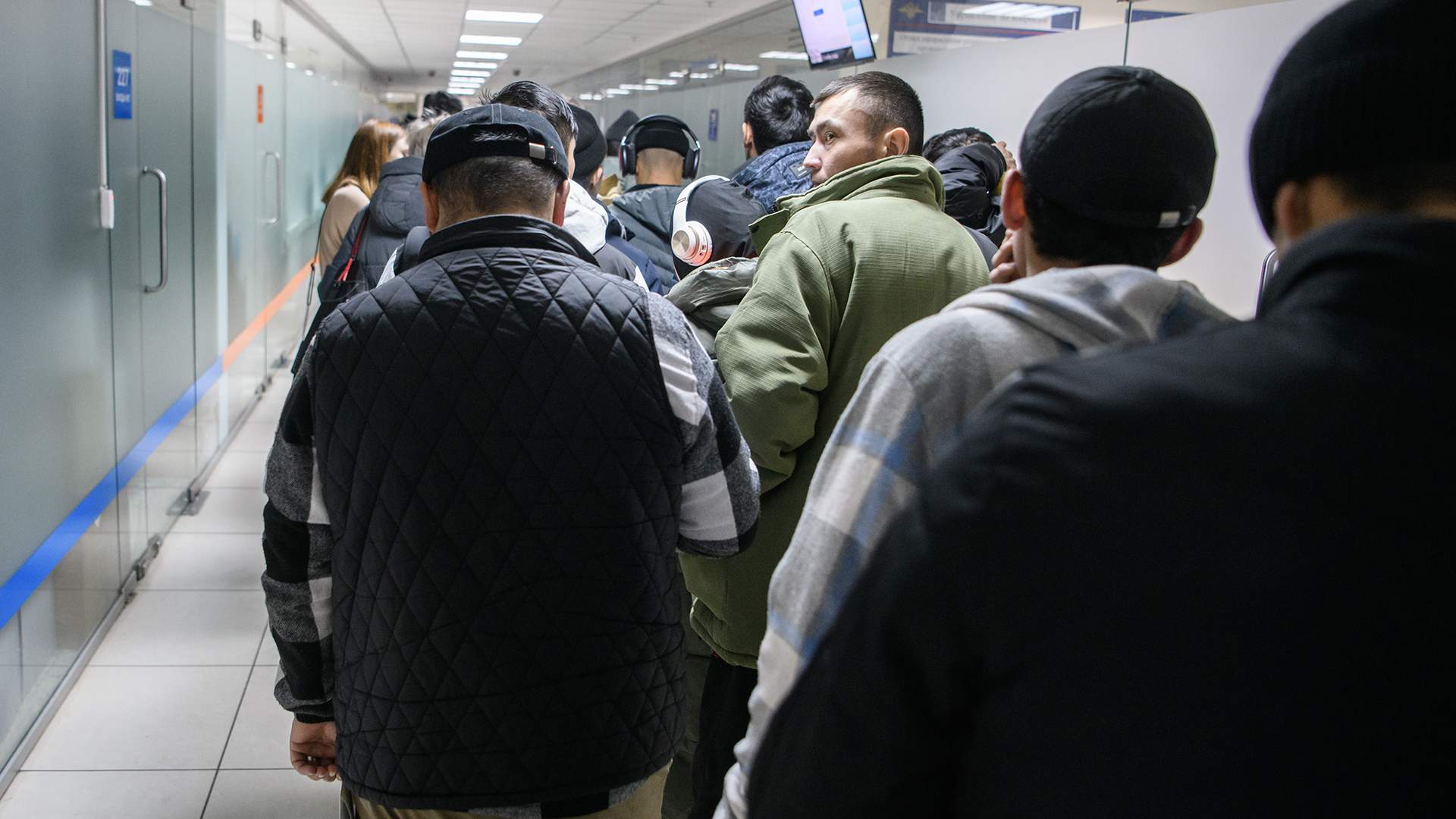
Illegal migrants from neighboring countries will come to the attention of modern digital technologies. This was stated in an interview with Dmitry Kiselyov by Moscow Mayor Sergei Sobyanina, who spoke about the development of digital mechanisms for controlling migration flows. Among them is a new mobile application that will allow you to request a geo-location and video confirmation of identity from migrant workers at any time. What illegal immigrants cannot hide from, and how their behavior will be tracked by "numbers" and "color" — in the Izvestia article.
To know a migrant by sight
Today, Russia has several control methods aimed at curbing illegal migration. These include photographing, fingerprinting, and taking DNA material upon entry into the country.
In addition, as soon as a foreign citizen finds himself on the territory of Russia, an electronic card becomes his "portrait" for the police, which "highlights" the visitor's status in a certain color: "red" implies being wanted, "yellow" means violations, and "green" allows him to remain in the country unhindered.
"Controlling migrants by traditional means, batons and roundups, is very difficult, almost impossible, given the scale of the city and the scale of migration flows," Sergei Sobyanin explained the need for digitalization.
Measures to combat illegal migration began to be introduced at the end of 2024. For example, since December 1, an experiment has been underway to strengthen control over the entry and exit of foreigners. At the airports of the Moscow air hub, they had to submit biometrics.
Since February 2025, restrictions have been imposed on migrants who are illegally in the country, who are included in the register of controlled persons and the database of the Ministry of Internal Affairs. Since June 30, 2025, the Russian government has provided for the formation of a digital profile, which should replace a paper patent in the future, and also announced the mandatory collection of biometric data upon entry of foreign citizens as part of stricter controls at all border points of the country.
It is also expected that from September 1, 2025, digital registration of migrants entering without a visa will start in Moscow and the Moscow Region, with mandatory registration through a special mobile application equipped with a geolocation function.
The editorial board of Izvestia sent inquiries to the Moscow government and the Ministry of Internal Affairs of Russia in Moscow. No responses had been received at the time of publication.
Under the plastic card
Alexey Karpunin, Director of Information Technology, founder of the IPWK Academy of IT Management, told Izvestia what digital surveillance of illegal immigrants is based on, aimed at improving security, strengthening compliance with migration legislation and optimizing interaction between government agencies.
Thus, according to him, digital control of migrants in Russia is carried out through a number of integrated systems and databases, including the electronic resources of the Ministry of Internal Affairs, the migration registration system, as well as specialized control mechanisms at border crossings and in the field of labor migration. The electronic plastic card has simplified the interaction of migrants with government agencies.
— It confirms the passage of mandatory procedures in the Multifunctional Migration Center of Moscow and is used as a travel document in public transport of the capital and the region thanks to the built—in function of the Troika card, - said Karpunin.
The plastic card is equipped with an electronic chip and contains the owner's personal data, information about the patent for the work and the payment of advance payments. The QR code reader system allows you to quickly verify your identity, purpose of visit, registration status and duration of stay in Russia. Additionally, the card can serve as a bank card, bonus card, or discount card, becoming a universal tool for migrants.
— Digitalization is already yielding tangible results: the efficiency of investigations is increasing, the time for data processing is decreasing, and the interaction between departments is becoming more coordinated. Facial recognition systems, big data analysis, and automation of routine tasks, such as query processing or database management, allow law enforcement officials to focus on solving more complex tasks," said Alexey Karpunin.
Maxim Tishakov, PhD in Law, Associate Professor of the Department of Law of the IEUIP GAOU at the Moscow State Pedagogical University, told Izvestia about the ruID mobile application, which works in seven languages. It appeared after June 30, 2025, when the second phase of the experiment began, providing for its implementation at all checkpoints across the state border.
— This electronic system includes various personal data of a foreigner, which allows for a qualitatively new level of control over these persons, including during labor migration: supervision of employers who attract foreign citizens, control of the order and conditions of their employment, prevention of fictitious employment, openness of migration processes, and the like, — said Tishakov.
According to him, in the future, it is expected to expand the use of artificial intelligence and further increase the transparency of migration control.
The formation of a comprehensive digital profile of foreign citizens when they cross the state border of the Russian Federation is still in the stage of its widespread implementation, Maxim Tishakov also emphasized.
— But today this system already indicates a qualitatively new level of digitalization of migration processes, their automation, integration with other public services and services. The purpose of the ongoing transformations is the timely prevention of violations of migration legislation, which in recent years has shown significant negative dynamics, countering illegal migration, and combating various kinds of illegal manifestations by foreigners on the territory of the Russian Federation," Tishakov said in a conversation with Izvestia.
According to him, the prospects for introducing a digital profile of foreign citizens are quite broad, providing for the possibility of automating routine migration processes, simplifying migration procedures, a new high level of control when foreign citizens cross the state border, increasing the effectiveness of combating illegal migration and ensuring the safety of society.
Legal digitalization
Lawyers note that the digitalization of migration control in Moscow and integration with the EPSU and the Interior Ministry systems have increased transparency and efficiency of administrative procedures.
— The introduction of electronic services for registration, extension of stay, and obtaining patents has really simplified the work for migrants and their employers. However, it is important to note that digital measures are primarily tools for control, not legalization. The legalization process has been and remains strictly regulated and often difficult to understand without legal support," explained Natalia Buslaeva, Managing Partner of Fidesz Law Firm and Head of Legal Business Support Practice.
In 2026, another system called "Migrant ID" will be launched in Russia. This was stated by Alexey Nechaev, chairman of the New People party, after the presidential decree on the creation of a "Digital profile of a foreign citizen" was signed on July 9.
"...Now a comprehensive digital control system is being introduced for migrants. As suggested by the New People, all information about migrants will be collected in one registry: biometrics, education and criminal records, diseases and medical insurance, language exams and certificates, mobile numbers. Even real estate and transport are owned," Alexey Nechaev explained the principle of operation of the application in his official Telegram channel.
As Nechaev explained, migrants will upload their data through a mobile application. Without registration in the registry, you will not be able to get a job, receive government services and open a bank account. In addition, the migrants themselves will pay for the development, launch and operation of the new system. To do this, the Ministry of Finance introduced seven new duties for migrants — for the issuance of a patent and the extension of a work permit, as well as for duplicates of migration documents.
"The migrants themselves should pay for the work of the system, not the citizens of Russia. The regions already spend millions of rubles on social support and benefits for foreign workers, and they definitely don't have to pay for their digital passports. <...> All this will bring 17 billion rubles a year to the budget. This money will be enough not only for the implementation of the "Migrant ID" system, but also for the re—equipment of border checkpoints," Nechaev stressed.
Natalia Buslaeva told Izvestia that if the introduction of "Migrant ID" is based on clear regulatory regulation and ensuring the protection of personal data in accordance with the Constitution of the Russian Federation and 152-FZ "On Personal Data", this could be a significant step towards simplifying procedures.
— However, it is important not to violate the principle of proportionality and not turn a technological tool into a means of excessive control. The issues of biometric data storage and access to them require special legal precision," said Buslaeva.
Sad trends
Compared to last year, the number of crimes committed by foreign citizens increased by 10% and amounted to 18.8 thousand acts. Such statistics were provided by the chairman of the Investigative Committee, Alexander Bastrykin, at an operational meeting on the investigation of crimes in the field of migration in early July.
"The number of crimes of increased public danger has increased. Thus, the number of sexual assaults committed by migrants increased by 22%. At the same time, the number of particularly serious crimes committed by newcomers increased by 57% (from 3,878 to 6,000). In total, almost 12.5 thousand foreigners have violated the criminal law of the Russian Federation this year," the official Telegram channel of the Investigative Committee quotes the head of the department.
Bastrykin stressed that incidents with migrants only fuel public discontent, and the antisocial behavior of newcomers, including women and children, has a serious destructive potential. According to him, many visitors not only do not want to comply with Russian laws, ignoring generally accepted norms, traditions and values, but also try to establish their own rules of conduct.
In addition, the UK notes the criminal behavior of underage migrants, in the vast majority of male adolescents. In 2024, their criminal activity increased by 8%, and in January-April of this year — by 13%.
Переведено сервисом «Яндекс Переводчик»
