
The truth is in the Dvina: what to see and eat in Arkhangelsk
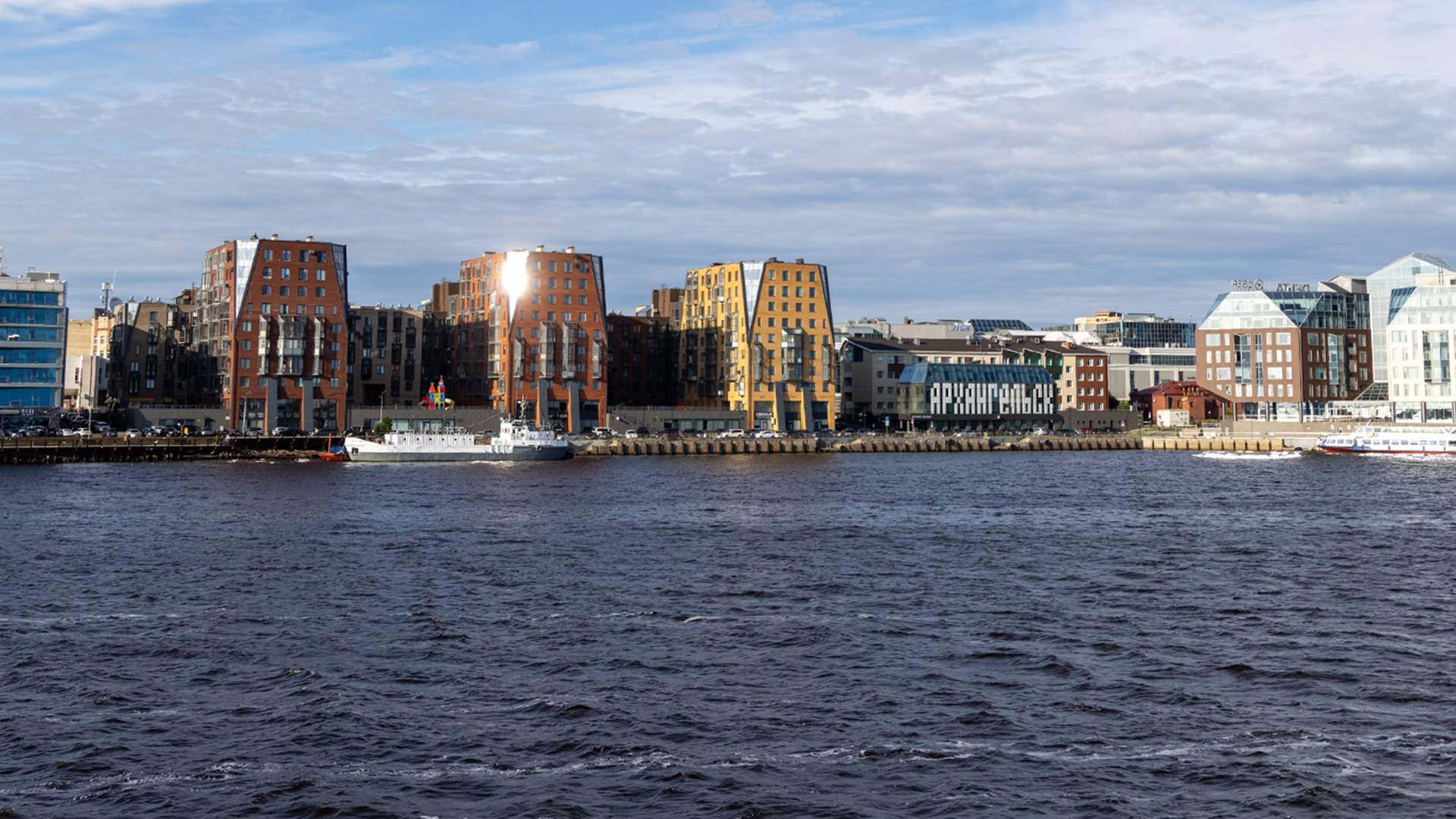
Arkhangelsk is a place where they are proud of their Pomeranian past and cherish it, where they consider their city to be the first gateway to Europe, only made in the Russian style, where they don't really like Peter the Great, but they really love the Northern Dvina. Arkhangelsk has preserved the authentic local cuisine, which is actively used by restaurateurs, and here, for the first time in the country, a full—fledged Russian breakfast was introduced, in defiance of the buffet, which captured almost all hotels in the country. Izvestia learned what to see and try in one of the main cities of the Russian North together with the Media Ambassadors project.
Russian-style window
If the guide tells you: "You've already heard and seen a lot in our city, so I won't burden you with history" — this means that now he will present you with his view on the founding and development of Arkhangelsk.

Drawbridge on the Northern Dvina in Arkhangelsk
The fact is that the locals love their city very much and are proud of its history. Of course, it's not even correct to call them Archangels, but Archangel City residents. It is impossible not to look back into the depths of the centuries: a long time ago this place was called the Arkhangelsk city, that is, the city that is located next to the Mikhailo-Arkhangelsk Monastery. Hence the name of the locals.
There are plenty of reasons to be proud of your city. Officially founded in 1584, Arkhangelsk has long been Russia's main port through which overseas trade was conducted. Already in the XVI–XVII centuries, it was thanks to the northernmost city of the country at that time that its inhabitants learned about Indian spices, coffee and other goods with which European merchants arrived here.

Severnaya Dvina Embankment in Arkhangelsk
The Russian Navy was also born in Arkhangelsk. It was founded, of course, by Peter the Great. But Peter is not very well liked here, although they honor him.
"Peter the Great is our negative character," says Sergey Samodov, director of the Arkhangelsk Drama Theater named after M.V. Lomonosov. — The population decreased by 40% under him. Men were rounded up for the construction of St. Petersburg - 5-6 thousand people annually! And he also increased the duty on trade through Arkhangelsk!
As a result, under Peter the Great, the volume of trade through this city decreased nine times, and St. Petersburg took over all the laurels of the main port of the Russian Empire.

Sergey Samodov, Director of the Arkhangelsk Drama Theater named after M. V. Lomonosov
Already in our century, the Northern Capital took away the white night from Arkhangelsk and our other northern cities and appropriated it for itself. Where are they going for white nights? To St. Petersburg. But the peak of white nights in this city is very short, and the nights are not that white. But in Arkhangelsk they last from May to the end of July. The sun sets, but not for long, and at the darkest time it becomes only a little twilight. It's very easy to go out and forget to go to bed — the only thing that should alert you at this moment is the absence of people on the street and closed shops and catering establishments. So far, the white night here is not crowded at all. This, however, has its own special charm.
And where do they go to look at drawbridges? To St. Petersburg. But Arkhangelsk also has them, and they are the northernmost in the world. They get divorced from about 2:00 a.m. to 5:00 a.m., so those who did not have time to move from one shore to the other will have to wait three hours to return home. The sight is said to be impressive: the bridge here is not exactly a drawbridge, but rather a lifting one — one of the tiers creeps up. If the automatic mechanism suddenly breaks down, 20 men can lift the bridge span manually.
Of course, none of the locals wants to quarrel with the Northern Capital. Russian russians don't want to be the capital of any kind here, either the cultural capital of the Russian North or the capital of the Russian Arctic.

St. Michael the Archangel Cathedral
— It seems to me that the number of capitals that appear in our country every year is already a bit absurd, — says Alexander Tsybulsky, Governor of the Arkhangelsk Region. — In principle, I believe that Arkhangelsk does not need an additional brand, because Arkhangelsk is 100% the cultural capital of the Arctic and the North. There are no more cultural heritage sites and such a deep history in the North.
In the meantime, local historians have nevertheless found and are happy to quote the words of the Minister of Finance of the Russian Empire, Sergei Witte, which he said in 1894: "They say that St. Petersburg was the first window cut from Russia to Europe, but the city of Arkhangelsk can reasonably dispute this comparison and add that it represents a window built by in a purely Russian style."
Pomeranian food
"In a purely Russian style" is important. Arkhangelsk is a northern city, and it's not for nothing that the Arctic begins here, as the inscription on the embankment says. And the Pomeranian traditions were "frozen" in this climate.
Pomors are not a people, but a subethnos. In fact, these are Russians who lived along the sea and went fishing. The local rivers and the White Sea are their main breadwinners: the logic of the proverb "if there is bread, there will be a song" has turned into the saying "if there is a sea, there will be bread."

View of the central part of the city of Arkhangelsk
But the cultural pressure on Arkhangelsk was intense.: Western merchants and sailors came here and brought with them not only outlandish goods, but also, for example, fashion, theater, jazz in the twentieth century... In the 17th century, due to the active trade with Western Europe in Arkhangelsk, even Gostiny Dvor was divided into Russian and German parts.

However, the Pomeranian traditions were not affected by this. Rather, they have enriched themselves. For example, they began to drink coffee in the Mezen way — with the addition of spices and, of course, salt. If there was no coffee, it could be replaced with malt or barley. And they cooked it right in the samovar.
— The children brewed coffee and then washed these samovars. And the adults drank, of course," laughs the founder of restobar JAM! Alexey Lyutarevich. — Now we often brew coffee in the Mezen style with the help of a purover, but actually it really turns out tastier and richer in the samovar.
Mezen coffee and several other items, such as cloudberry raf, were presented by Alexey Lutarevich and his team at the Pomorskaya Food festival on the last weekend of June. Here, local restaurateurs showed how well they remember their roots in Arkhangelsk, at least in food.

— The development of local cuisine began in 2017-2018, when they began to remember: and it turns out that we not only have pizza and sushi, but also have cool shang, wickets with lingonberries, and our own drinks, — says Alexey Lutarevich. — During the Soviet period, the tradition of brewing coffee in Mezen style disappeared, but we managed to find recipes.
Alexander Reshetov, the owner of the Kholmogorskaya Bakery, shows Pomeranian rolls of various types at the festival. One of them, with a handle to make it easier to eat, was named "Afanasievsky" and began to be produced with lemon filling. It turns out that at the end of the XVIII century, this fruit was grown in Kholmogory by Archbishop Athanasius!
— We are looking for information about traditional baking by communicating with local grandmothers, restoring their recipes, — Alexander Reshetov told Izvestia. — There was even a case when a grandmother came to the bakery in Shenkursk, handed over a piece of paper and said: "Here, girls, I've been cooking pies according to this old recipe all my life. Save it."
The traditional local sweet, with the exception of rolls and the wickets already familiar to the Russian North, is, of course, a goat. It's a painted gingerbread, but it tastes like gingerbread cookies. The trick is in the burnt sugar that is added during cooking.

Alexander Reshetov, owner of the Kholmogorskaya Bakery
In the Arkhangelsk region, you can try not only traditional pastries, but also, for example, pomakukha — soup with thick fish broth. There was even a cooking championship at the Pomorskaya Food festival. Restaurateurs from several regions competed, and representatives of Kamchatka, of course, decided to cook crab pomakuha.

The Russian Breakfast project was launched at the same festival. Instead of the usual buffet with the usual European food, 12 locations throughout the region will now offer visitors Russian, or rather, Pomeranian food. Arkhangelsk became the first city in which the Russian breakfast was introduced into the menu on a permanent basis.
For example, the Belomorsky restaurant presented a full-fledged set based on the tales of the legendary Arkhangelsk storyteller and artist Stepan Pisakhov.

Roast with White Sea herring at the Belomorsky restaurant
— I have three children, we read his fairy tales all the time. And when the idea of a Russian breakfast appeared, I decided to look through the book," says Lyubov Chernova, director of the Belomorsky restaurant. — I came to the chef with this concept and said: let's think about how to make a full-fledged menu out of fairy tales.
This is how the breakfast menu included rye breadcrumbs, oatmeal porridge in mushroom broth with onions, pea porridge with milk, Pomeranian casserole of cod in cottage cheese, egg pancakes with cod liver and lingonberry jam, roast with White Sea herring, etc.
The Pomorsky restaurant has formed four dishes thanks to expeditions in the Arkhangelsk region. These are, for example, pancakes from the village of Verkhnyaya Toyma — a thick pancake on sour milk, which is served with cranberries and oatmeal. Or Pomeranian fried eggs with shilegs from the village of Kimzha in the Mezen region.

One of the variants of the "Russian breakfast"
"This is a recipe that our grandmothers used," says Anna Starostina, manager of the Pomorsky restaurant. — Eggs are beaten with milk, put in the oven. It turns out something like an omelet. It is served with charcoal—baked bread and Kimjong shilegs, which is sheep's fat that is melted with garlic and onions. It turns out to have a very piquant, original taste.

Pomeranian food is generally widely available in local restaurants. One of the most famous establishments, the Post Office 1786, can, for example, offer sprats from Kenozerskaya grouse on baked potatoes. Dmitry Amelin, the chef of the Post Office, who moved to Arkhangelsk from St. Petersburg, admits that it was the sprats from the local ryapushka that became for him one of the main gastronomic discoveries in the region.

Kenozerskaya grouse sprats on baked potatoes
Here, as in many other establishments in Arkhangelsk, they offer Finnish fish soup, calling it Pomorskaya. But the city does not forget about the classic Russian fish soup: the Headquarters restaurant makes it without any milk, but with three types of fish — cod, salmon and halibut.
Of course, there are a lot of mushroom dishes everywhere — the forests of the Arkhangelsk region are very rich in this product. For example, classic pickled mushrooms with sour cream can be tasted in the museum-reserve "Malye Korely" in the "Tea House No. 2".
Such rich pomors
But the main thing in Small Korels is not food, of course. It is one of the largest open-air museums in the country dedicated to Russian wooden architecture. The 140-hectare area includes peasant houses, chapels, bell towers, and mills. They were transported, disassembled by logs and reassembled from different villages of the Arkhangelsk region, in order to save them from oblivion and show how the Russian people lived in the North. The first exhibit, which appeared back in the 60s, is a 16th-century tent bell tower. It is also the oldest building of the museum complex.
You can walk and look at wooden houses all day. Here, for example, is the house of Klokotov from the village of Zaozerye. The owner wanted to show his wealth, so he made a decorative balcony and covered the walls with drawings. The choice of characters for painting is interesting — these are lions! They were generally loved here, sometimes affectionately called "overseas cats."

Museum-reserve "Malye Korely"
And here is the Ascension Church of the 17th century. The domes are covered with scaly aspen ploughshares.
— When the tree is fresh, it glows with gold, but eventually turns into silver, — says the guide Natalia Skomorokhova. — Recently, the domes were restored, so now there is a miraculous transition from gold to silver. And in the old days, merchants who saw our churches from afar said: the Pomors are so rich that they cover the domes with gold!

What else to see in and around Arkhangelsk
Arkhangelsk is generally very rich in a variety of impressions.
— For me, Arkhangelsk is the orange sun of the Russian North and the warmth of its people, it is the forty—year history of jazz, it is the mystery of the ice age — the purification not only of nature, but also of oneself. These are vibrant theatrical productions, this is a city with its own style and taste, the cradle of culture and traditions of the Russian North," says Amalia Akopova, author of the Media Ambassadors project and presenter of Moscow FM.

Arkhangelsk pedestrian street, on the left – Senya Malina, a character in Stepan Pisakhov's fairy tales
It should be added that this is also the White Sea, although it is better to look at it from neighboring Severodvinsk. The Yandova Guba tourist complex is currently developing there: you can go boating and sailing, fishing, experience ice-floating — or just enjoy the silence on the shores of the White Sea.
Arkhangelsk itself has a unique algae plant in the country. Kelp and fucus are harvested here, which are used to produce cosmetics, medicinal products and food products such as chips. Harvesting is carried out in the Solovki region, but, interestingly, this particular fishery was completely out of character for the Pomors: they did not look at algae as a food product. But now you can visit not only the algae plant store, but also a curious museum.

Fucus, which is extracted and processed at an algae plant in Arkhangelsk
There are many interesting museums in the city. The Museum of Local Lore is located in the well-preserved rooms of the Living Rooms. It is worth visiting the Stepan Pisakhov Museum, the Alexander Borisov Museum of Artistic Exploration of the Arctic, the Arkhangelsk Museum of Fine Arts, and the Northern Maritime Museum.

The paddle steamer Gogol is waiting for lovers of river trips in Arkhangelsk. It was built more than 100 years ago, and it is the oldest passenger ship in Russia, which is in regular operation. Moreover, it runs on the same engine and side paddle wheels as it did 100 years ago! Guests of the steamer can be shown the internal structure of the vessel. And recently, the local Arkhangelsk Drama Theater used this ship as a venue for its immersive play "The Pomeranian Ark".

Steamship "Gogol"
Immersive productions are one of the features of the local drama theater. The second such performance is called "Pomorskie knots". This is an hour-long walk around the city, which allows you to immerse yourself in the history of Arkhangelsk through several personal stories of Arkhangelsk residents from different eras. Perhaps, of all the ways to get to know this city, this is the best. Arkhangelsk has a tangible image, and the wide and so close Northern Dvina is felt as the source of life and meanings of this city. Local designers have long reinterpreted the phrase "truth in wine", turning it into "truth in Dvina". And you can really feel it in Arkhangelsk.
Переведено сервисом «Яндекс Переводчик»
