Sales conditions: Russia's trade volume may reach almost $1 trillion


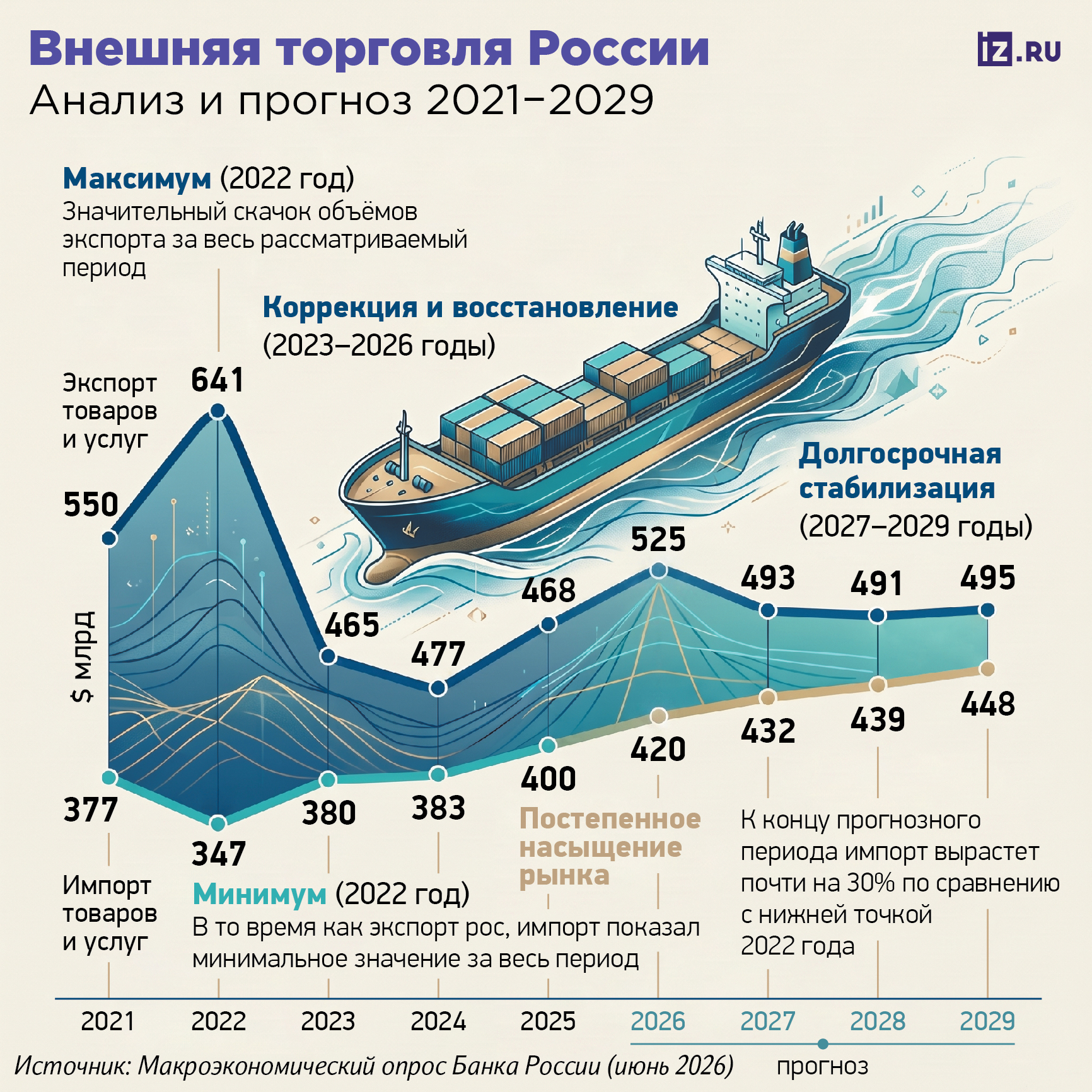
Russia's foreign trade turnover may increase by 10% in 2026 and reach almost a trillion dollars. Exports of goods and services will approach $525 billion, while imports will reach $420 billion, according to analysts interviewed by the Central Bank (Izvestia analyzed these data). The main driver will be the growth of revenue from the sale of expensive oil. However, the situation will depend on the conflict in the Middle East. After a brief lull, tensions around the Strait of Hormuz have increased again. How realistic are the expectations of the regulator's analysts and how Russia can increase trade are discussed in the Izvestia article.
What will happen to Russian trade in 2026
The volume of trade in goods and services of the Russian Federation this year may amount to about $945 billion. Imports can reach $420 billion and exports $525 billion, according to analysts polled by the Bank of Russia in June. This is almost 10% higher than last year's turnover. At the same time, compared with the April survey, experts raised their expectations: previously, they had invested $412 billion for imports, and $506 billion for exports.
Russia's trade has already grown this year. According to the Central Bank, exports of goods in the first four months amounted to almost $140 billion, while imports totaled just over $100 billion. This is almost 8% more than last year. The editorial board asked the Central Bank what would support the indicator this year.
The press service of the Ministry of Economy told Izvestia that the expansion of free trade zones, the active work of intergovernmental commissions (IGCS) with the maximum involvement of business, an increase in the share of settlements in national currencies, as well as effective customs and tariff regulation, taking into account the balance of interests of producers and consumers, contribute to the development of foreign trade.
According to experts interviewed by Izvestia, there is a high probability that the trade turnover of the Russian Federation in 2026 will indeed approach $ 1 trillion. The main driver will be the growth of revenue from the sale of expensive oil, explained Vladimir Eremkin, senior researcher at the Laboratory of Structural Research at the Presidential Academy. Supply disruptions through the Strait of Hormuz, which have occurred due to a new round of conflict in the Middle East, are the main source of an increase in global quotations. At the moment, Brent and Urals brands were priced above $110 per barrel. However, after signing the memorandum for 60 days, prices quickly went down. At 18:00 Moscow time on June 29, Urals was worth $58.5 per barrel, and Brent was at $73 per barrel.
At the same time, the energy crisis is not the only factor. The actual trading volumes were also growing. Significant expansion has now taken place in the agro-industrial complex, the field of high-tech services, the medical industry, as well as in the segment of deep product processing, said Arthur Leer, President of the Association of Exporters and Importers, Managing Partner of Lex Alliance. The indicators in mechanical engineering have also increased significantly, he added.
At the same time, not only the product itself becomes important for business, but also the ability to quickly, reliably and predictably make international payments, says Anton Nikitin, founder and CEO of Fingold. He added: it is the development of the payment infrastructure that largely determines how successfully Russian companies will be able to further increase foreign trade in almost all segments.

Who is Russia building trade relations with?
China remains the undisputed leader among our country's key partners. In the first five months of this year, Russia's trade with China increased by almost 23% to $110 billion, according to Chinese customs data. Russia mainly sells oil, natural gas and coal to Beijing. Copper ore and copper, timber, fuel and seafood are also among the supplies. At the same time, Moscow buys cars, machinery, industrial and specialized equipment, children's toys, and alcohol.
India is also among Russia's largest trading partners, which has significantly increased imports of our oil and petroleum products in recent years, Olga Gogaladze said. Our country also maintains relations with Turkey, which provides logistics and supplies a wide range of goods.
The CIS countries, primarily Belarus and Kazakhstan, also make a significant contribution to the trade turnover. They remain key partners of the Russian Federation in the field of industry and trade, the expert explained.
To accelerate the growth of Russia's foreign trade, it is necessary to expand exports to the friendly countries of Asia, Africa, BRICS and the Eurasian Economic Union (which also includes Armenia, Belarus, Kazakhstan and Kyrgyzstan), not only in the oil and gas sector. It is also worth expanding cooperation in the fields of nuclear energy, metals, food and green technologies, explained Natalia Milchakova, a leading analyst at Freedom Global.
An increase in the supply of equipment and components through partner countries will also contribute to the growth of imports necessary for the development of domestic production, said economist Olga Gogaladze. At the same time, it is important to continue adapting trade to sanctions restrictions through the development of settlements in national currencies and reducing dependence on the dollar, Natalia Milchakova believes.

How does the situation in the Middle East affect the Russian economy
The escalation in the Middle East increases uncertainty in commodity markets, affects the cost of oil, logistics and transportation insurance, and this in turn affects trade volumes, explained Anton Nikitin from Fingold.
On the night of June 18, after 3.5 months of military conflict, the United States and Iran signed a memorandum of understanding. The document consolidated the preliminary settlement agreements and opened the way to negotiations on a broader agreement. The countries must negotiate a final agreement within 60 days after the agreement is finalized.
However, on the night of June 27, the US army launched new attacks on targets in Iran in response to an alleged violation of the ceasefire. The next day, Donald Trump threatened that in case of further escalation, the United States could take harsh measures, including the destruction of the Islamic Republic.
— Now Iran wants to retain the right to control the Strait of Hormuz, while the United States is interested in completely free navigation. This is becoming the formal reason for the new escalation. However, it is worth noting that there are too serious disagreements between the parties and a mutual lack of trust, which does not allow us to ensure reliable terms of the agreement," explained Vladimir Eremkin from the Presidential Academy.
He clarified: at the same time, channels of diplomacy are open, and the parties continue negotiations.
After the signing of the peace agreement, oil prices dropped significantly, while they practically did not respond to the news of the resumption of hostilities. Experts interviewed by Izvestia believe that the risk of a new round of conflict is still high.
A prolonged standoff in the long run will still push up commodity prices. However, this is possible with a significant new escalation of the conflict. In this case, Brent may exceed $90 per barrel, and Urals may rise to $70-75 per barrel on average per year, analysts believe. With this picture, additional budget revenues may amount to up to 2 trillion rubles. The liquid part of the National Welfare Fund will start to grow, and the government will receive a comfortable cushion in case of new shocks, explained economist Olga Gogaladze. Another rise in oil prices will also further boost Russia's trade turnover.
So far, it seems unlikely that the conflict in the Middle East will end definitively in the next few weeks. However, if this happens, the additional revenues of the Russian budget will remain much more modest — at the level of 800 billion rubles, Izvestia wrote earlier.
Переведено сервисом «Яндекс Переводчик»
