
Coming into fashion: new eco-friendly marine engines will be launched in Russia

Russia is preparing to launch production of its own eco-friendly engines for cargo ships. Now this fleet is very worn out: 68% of domestic tankers and 76% of dry cargo ships have been in operation for more than 30 years. We are talking about a motor running on gas and fuel oil at the same time — it emits fewer harmful substances. The contract for the development of its most complex components was signed on February 13 by the United Shipbuilding Corporation and a large engineering center from St. Petersburg, Izvestia learned. The Bryansk design bureau joined the project. The cooperation of the enterprises will create engines for dry cargo ships, tankers and gas carriers, including those operating on the Northern Sea Route.
What are dual-fuel marine engines for?
Engines for Russian dry cargo ships, tankers and gas carriers will run on various types of fuel, the first prototype of such a motor should appear before the end of 2028. The United Shipbuilding Corporation (USC) told Izvestia about this. To develop a low-speed engine technology platform (MOD) for a large-capacity fleet (from 20 thousand tons and above), a cooperation of design bureaus and engineering centers is being created.
The first contract under the MOD project was signed on February 13 between USC-Dvizhenie (a subsidiary of USC) and a large engineering center from St. Petersburg, which has expertise in manufacturing key elements of the power plant. The Bryansk Design and Technology Bureau, established at the end of 2025, will also join the cooperation.

Nikolai Patrushev, Chairman of the Marine Board, spoke about the requirements for the creation of dual-fuel marine engines on February 17 at a meeting on marine engine construction in St. Petersburg. According to him, a single competence center may also appear on the basis of the National Research Institute. academician A.N. Krylov. In addition to dual-fuel units, the shipbuilding program until 2050 involves the creation of gas turbine, combined and other types of power plants.
"So far, three design bureaus have been involved in the implementation of the MOD project, but the possibility of further expanding resources is being considered," Sergey Bondarenko, USC Deputy General Director for Development and Operational Efficiency, told Izvestia.

The Russian cargo fleet is badly worn out. According to the strategy for the development of the Russian shipbuilding industry, 68% of domestic tankers have been in operation for more than 30 years. The situation is similar in the dry cargo segment: 76% of ships are also older than this age.
The Bryansk Design Bureau is faced with the task of preparing the production of the MOD in a short time and issuing design documentation in the first half of 2026. According to him, the new Design Bureau includes specialists with work experience at the Bryansk Machine-Building Plant, which has been producing marine engines under license from MANB&W Diesel A/S (Denmark) since 1961. After 2011, the plant lost the equipment and competencies necessary to resume production, he noted.

According to USC, the engineering center from St. Petersburg will develop and manufacture the most complex components of the MOD, such as a turbocharger, a blower, a cylinder lubricator (a device for lubrication), and more.
The production of a prototype MOD, testing and certification are planned for 2027-2028, the USC said. The prototype will consume diesel and heavy fuel. This unit should become the basis for the subsequent development of a serial dual-fuel MOD that also runs on natural gas. In the longer term, the use of other fuels such as ammonia and methanol on the MOD is not excluded, the corporation noted.
"The dual—fuel capacity of engines is determined by the economics of transportation and international environmental requirements," Nadezhda Malysheva, Director of Development at the PortNews information and analytical agency, told Izvestia. — The International Maritime Organization (IMO) sets the stages for reducing harmful emissions, including for marine vessels. Switching from fuel oil to natural gas reduces emissions of sulfur dioxide, nitrogen, carbon dioxide and particulate matter. In addition, it is logical to use the gas MOD on large—tonnage gas carriers.

According to her, as part of the "green" trend, experiments are underway with other fuels, including methanol (industrial alcohol) with zero sulfur emissions. Manufacturers are considering the possibility of converting marine power plants to different types of fuels, but this does not mean that the age of oil in shipbuilding is over. If they run on fuel oil, for example, on tankers, then they use scrubbers to clean exhaust gases, she notes.
— The use of low—speed engines is economically feasible on transport vessels with or without a low ice class, - says Sergey Bondarenko. — This does not exclude the possibility of installing MODS on ice-reinforced vessels and using them on the Northern Sea Route. There is such an experience: vessels with MOD can follow in light ice independently or in the channel behind an icebreaker.
According to him, the production volume of the MOD has not yet been determined and will depend on the demand for large-tonnage vessels.
"The formation of the order portfolio is still in progress, but we proceed from the planned capacity of the Severnaya Verf, which ranges from 9-11 large—tonnage vessels per year," he told Izvestia.
Earlier it was reported that the first large-tonnage vessels at the modernized Severnaya Verf in St. Petersburg will be laid down in 2030.

The United Shipbuilding Corporation did not comment on the volume of investments in the MOD project.
According to Finam Management Management Company, the project to create a low-speed engine for a large-capacity fleet may require approximately 203-207 billion rubles at the preliminary stage, including development, testing and preparation for mass production.

Izvestia sent inquiries to the Ministry of Industry and Trade and the Bryansk Machine-Building Plant.
How many ships will be needed to replenish the fleet
As explained by Izvestia's interlocutor at the shipbuilding corporation, there are now three major MOD development centers in the world: the Everllence division (formerly MAN Energy Solutions) in Denmark, WinGD (formerly Wartsila-Sulzer) in Switzerland and J-ENG in Japan. But recently they were joined by the Chinese corporation CSSC, which initially produced engines under Everllence and WinGD licenses, but about 10 years ago it made its own marine unit. In 2025, she supplied two engines for bulk carriers with a lifting capacity of 35 thousand tons, he said.
"Now, because of the sanctions, there are difficulties with the supply of mods to the Russian Federation from the global market," Alexander Spiridonov, deputy chairman of the State Duma Committee on Industry and Trade, told Izvestia. — However, the growth of cargo turnover on the Northern Sea Route and in other regions of the World Ocean requires the development of a sovereign Russian large-tonnage fleet.

According to him, after the USSR there was a significant decrease in the production of large-tonnage vessels, which is why they are now extremely scarce. Therefore, foreign ships are widely used, and this will continue until they are replaced. In this regard, according to the deputy, it is extremely important to create a domestic production of low-speed engines with state support.
— Without modern marine engines in Russia, it is impossible to build large—tonnage vessels with a carrying capacity of 50-90 thousand tons and above, the need for which is rapidly increasing, - said Nadezhda Malysheva from PortNews. — Deadlines have been set for MOD developers. It usually takes five to seven years, but they need to make it by 2030. Therefore, reverse engineering methods can be used to speed up the design process.
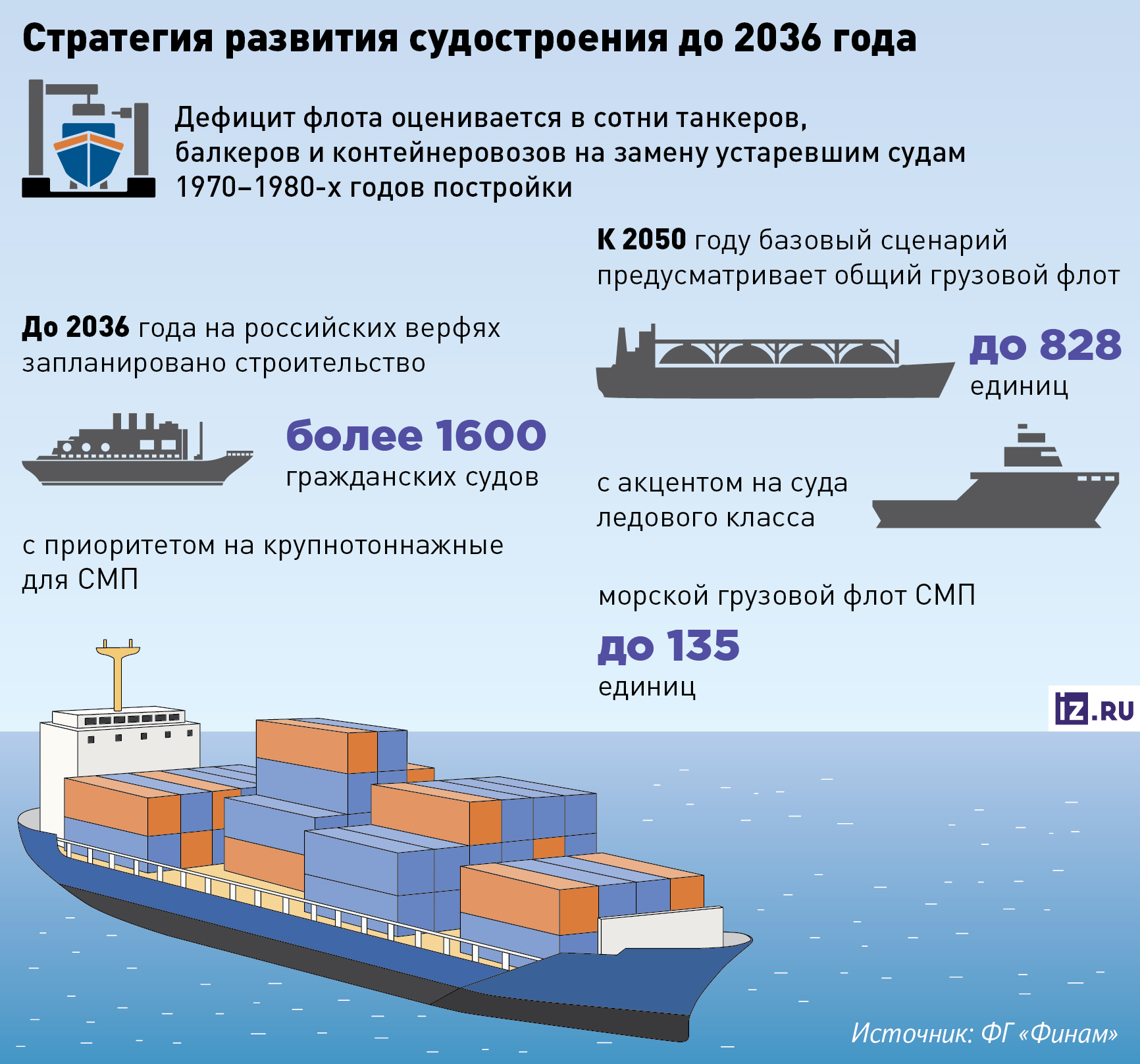
The shipbuilding development strategy estimates the fleet deficit at hundreds of units, especially tankers, bulk carriers and container ships to replace obsolete ships built in the 1970s and 1980s, Dmitry Baranov, a leading expert at Finam Management, told Izvestia. By 2050, the basic scenario for the development of the cargo fleet provides for the construction of up to 828 ships with an emphasis on ice—class vessels, and the marine cargo fleet of the Northern Sea Route - up to 135.
According to him, the vessels are planned to be used for transportation to the countries of the Asia-Pacific region, the Middle East and the Global South. They will transport oil, gas, containers, as well as dry, bulk and specialized cargoes throughout the oceans, including routes along the Northern Sea Route.
Переведено сервисом «Яндекс Переводчик»
