
Flu has grown: schools and kindergartens in dozens of regions are being quarantined

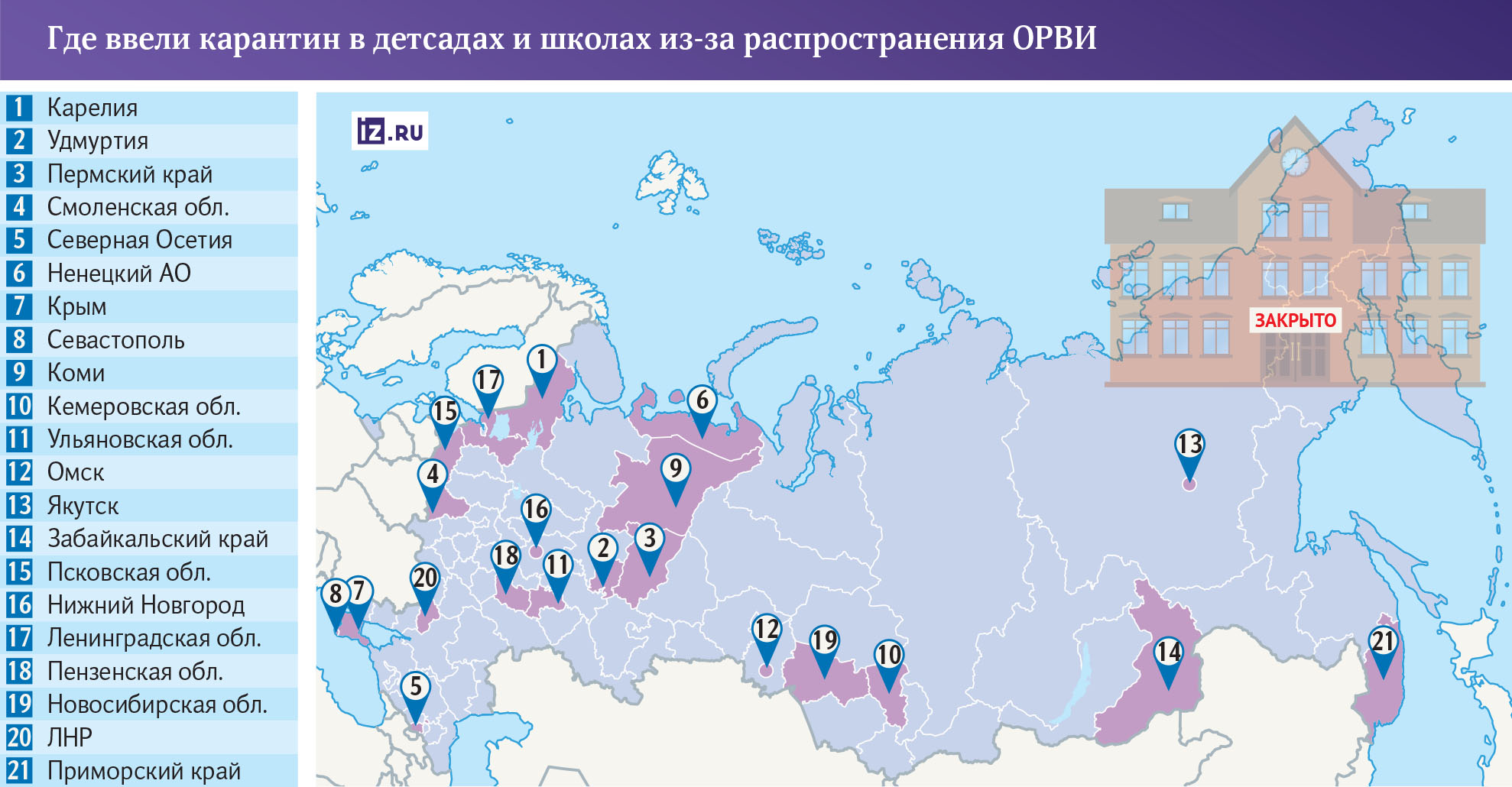
At least 20 Russian regions have begun quarantining classrooms in schools and groups in kindergartens over the past week. The reason is the high rate of SARS spread. Quarantine among children is being introduced in Karelia, Udmurtia, the Nenets Autonomous District, Crimea, Komi, Perm and Trans-Baikal Territories. For example, 105 classrooms in 43 schools and 77 groups in 47 kindergartens were quarantined in the Perm Region. Experts believe that the latest wave of morbidity growth is underway, the highest point of which will be reached in March. Rospotrebnadzor called the infection rate stable.
The spread of acute respiratory viral infections in Russia
In the seventh week of 2026, the incidence of acute respiratory viral infections and influenza increased by 4.5% — 775 thousand cases were registered, Rospotrebnadzor reported on Tuesday. The agency called the incidence rate stable.
"The incidence rate corresponds to the level of the beginning of October 2025," they said.

At the same time, since the beginning of this week, regions have been massively reporting quarantine closures not only of individual classes in schools and groups in kindergartens, but also of children's institutions in their entirety.
On Monday, partial and complete closure of children's institutions was announced in the Smolensk, Omsk, Ulyanovsk, Kemerovo regions, Perm and Primorsky Territories, North Ossetia, Yakutia, Komi and Udmurtia, as well as in the Northern Administrative District. On Tuesday, quarantines were reported to have begun and are continuing in the Leningrad, Pskov, Novosibirsk and Nizhny Novgorod regions, as well as in the Trans-Baikal Territory, Karelia and the LPR.

There are child quarantines in Crimea and Sevastopol. And in a number of regions, quarantines announced last week are continuing, for example, in the Penza region.
In the Perm Region, 77 groups in 47 kindergartens, 105 classes in 43 schools, and 23 groups in secondary specialized educational institutions were quarantined, the local Rospotrebnadzor reported.

In Karelia, 67 classes in 27 schools, seven groups in four kindergartens, one group in a boarding school in Petrozavodsk and a school in the Pudozhsky district of the republic were suspended. In Udmurtia, it was announced that the number of SARS cases increased by 6% compared to the first week of February, with the majority of those infected being children under the age of 14.
— The educational process has been partially suspended in 25 classes of 18 educational institutions, in 37 groups of 29 preschool educational institutions. One school in the Glazovsky district and one kindergarten in the Vavozhsky district are completely closed," the republican Rospotrebnadzor reported.

In Crimea, quarantine was introduced in 64 classes of 40 schools and 46 groups in 37 kindergartens. In Sevastopol, the educational process in 28 classes and seven groups was partially suspended. And in Komi, 52 classes in 25 schools and 13 groups in 13 kindergartens went into quarantine in the middle of last week.
Why is the incidence increasing
The epidemic season passes with two, three, and sometimes four waves of rising morbidity, Elena Malinnikova, MD, an infectious disease specialist and virologist, told Izvestia.

— In each period, diseases caused by different viruses prevail. The last wave was triggered not by the flu virus, but by a rhinovirus infection," the doctor explained. — Most often, the last wave of the rise in morbidity occurs at the end of February — the beginning of March, sometimes it captures April, depending on how quickly this infection develops or how anti-epidemic measures were organized.

Gennady Onishchenko, Academician of the Russian Academy of Sciences and Deputy President of the Russian Academy of Education, believes that the seasonal rise in influenza and acute respiratory infections is continuing, and it will end only in April.
— According to the data of the sixth week, the average annual incidence rate has not been exceeded in any region, although there is an increase in some places, a decrease in others, - said the expert.
According to sanitary and epidemiological rules and regulations, the educational process in organizations is suspended if more than 20% of children are ill. According to Gennady Onishchenko, the introduction of restrictions is a necessary solution, as it allows breaking the epidemic chain and prevents the disease from spreading.

The incidence of acute respiratory viral infections in Russia usually peaks from November to the end of February, Alexey Bessmertny, an allergist and immunologist at the Soft Medical Center clinic, told Izvestia.
— Children are more likely to suffer from respiratory viral infections, because their immunity is only being formed and does not adequately respond to all viruses. In addition, they visit such large institutions as schools and kindergartens, where the infection spreads faster than among adults at work," he said.
If flu and acute respiratory viral infections start to spread in a school or kindergarten, then it is logical to declare quarantine or transfer students to a distance so that everyone does not get sick and wait out this peak period, Alexey Bessmertny pointed out.

The peaks of the spread of SARS and influenza from year to year occur after the holidays, Vladislav Zhemchugov, MD, immunologist, told Izvestia. February is just the period after the New Year holidays and school holidays.

But at the moment, this is not yet the peak, says infectious disease specialist Evgeny Timakov.
"The incidence is increasing now," he explained to Izvestia. — In order to avoid an epidemic, preventive measures are being carried out, including the closure of individual classrooms for quarantine.
Evgeny Timakov believes that the increase in morbidity will continue in the near future.
"This will be facilitated by weather conditions and the circulation of viral infections, they have a certain seasonal character," he added.

According to the doctor, when the weather is changeable, sometimes it gets warmer, sometimes it gets cold, the virus feels comfortable and stays in the air longer. In the cold season, people ventilate the premises less often, which also contributes to an increase in morbidity.
— The end of February — the beginning of March is typically the second, even the third increase in morbidity, including influenza infection, — said the expert.
According to him, the peak incidence should be expected approximately in the first or second week of spring.
Переведено сервисом «Яндекс Переводчик»
