
Transfer to map: Russia approves creation of a new gambling zone

A sixth gambling zone may appear in Russia. The Cabinet of Ministers approved the draft law of the Ministry of Finance on the creation of such an object in the Altai Republic. Currently, there are four gambling zones in Russia — in the Altai, Krasnodar and Primorsky Territories, as well as the Kaliningrad region. In Crimea, this project is under construction. The new facility will create new jobs and increase the tourist flow to the region, the authors note. And the Institute of Legislation and Comparative Law believes that the project will also contribute to "overcoming the subsidization" of the region. How the new site will function is described in the Izvestia article.
Develop Altai
The sixth legal gambling zone is planned to be opened in Russia. Such a bill of the Ministry of Finance was approved by the government commission on legislative activity on Monday, December 22. This was reported to Izvestia by sources in the Cabinet of Ministers.
The Republic of Altai will become the new entity on whose territory such a zone will be created.

Views of the Altai Republic
The bill proposes a balanced development of the current model of gambling localization, believes Vladimir Gruzdev, Chairman of the Board of the Russian Bar Association.
"This decision is of an applied economic nature and is aimed at creating a new center of attraction for a certain segment of tourists," he told Izvestia.

Currently, there are four gambling zones in Russia: Sibirskaya Moneta in the Altai Territory, Primorye in the Primorsky Territory, Yantarnaya in the Kaliningrad Region and Krasnaya Polyana in the Krasnodar Territory. The fifth is located in Crimea, but the project is still under implementation. The Golden Coast gambling zone was initially planned to be built in the urban-type settlement of Katsiveli, but in 2024 the President of Russia signed a law on its relocation to the site of the seaport in Yalta.
The ban on gambling and casinos has been in effect in Russia since July 1, 2009. Any gambling activity conducted outside the official gambling zones (with the exception of bookmakers, sweepstakes and lotteries) is prohibited.
The main purpose of the bill is to create an additional impetus for the socio—economic and tourist development of the Altai Republic, Vladimir Gruzdev said.

"The launch of the gambling zone is positioned as a tool for regional development that will unlock the existing tourist and recreational potential of the territory, ensure an influx of investment in infrastructure and services, and in the long term create new jobs and increase tax revenues to the budget," explained the Chairman of the Board of the AYUR.
According to him, from a legal and economic point of view, the bill is a consistent step within the framework of the current strict regulatory model. It does not change the general prohibitive principles of Russian legislation, but only adapts the list of territories to meet the current challenges of regional development.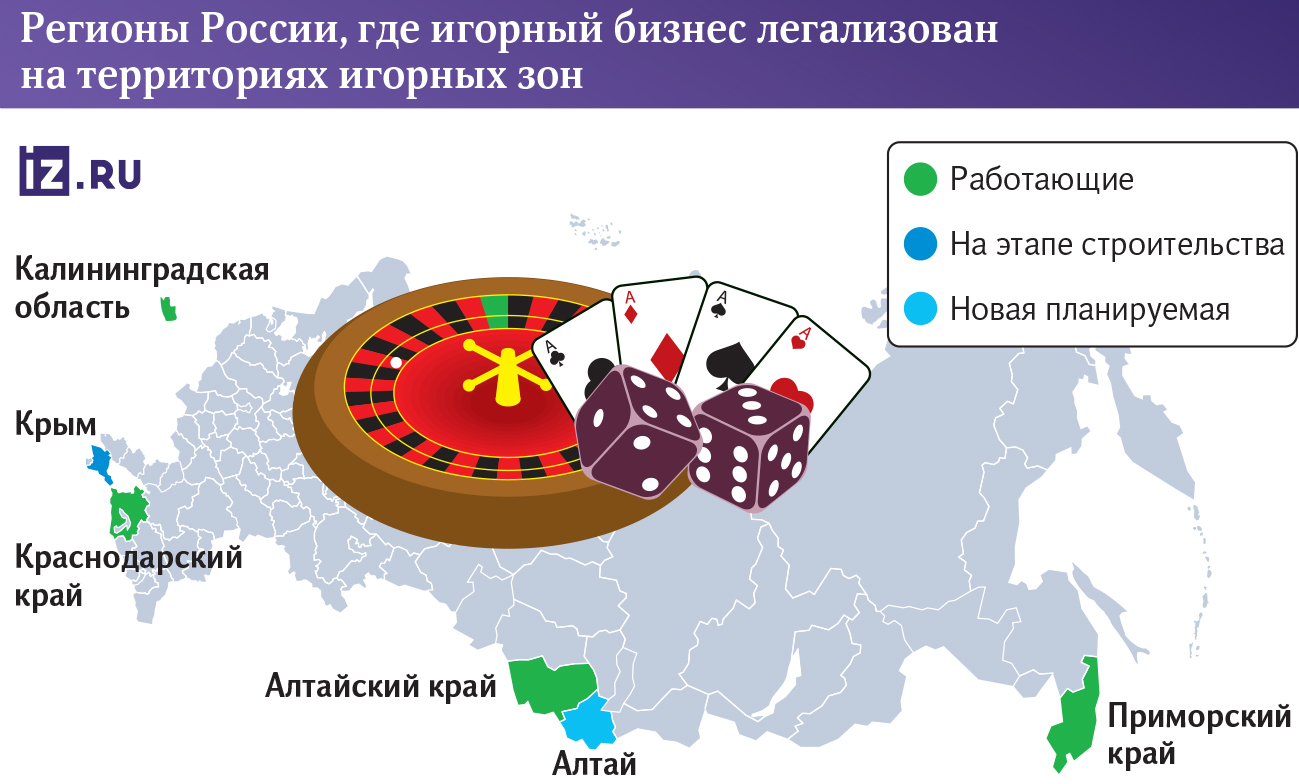
— The initiative demonstrates an approach that maintains a balance between strict state control over the turnover of gambling and the use of this regulation as a tool of regional policy, — said Vladimir Gruzdev.
How are gambling zones developing?
In recent years, Russia's existing gambling zones have shown a steady increase in tourist attractiveness and economic activity, the press service of the Association of Entertainment and Event Tourism Industry Operators (AIRIS) told Izvestia. In the incomplete year 2025, more than 1.7 million guests visited Russian gambling zones, which exceeds last year's figure by about 4%.

View of the casino of the Krasnaya Polyana gambling zone
"The format of multifunctional entertainment clusters, implemented in regions such as Sochi, Primorye, Kaliningrad Region and Altai Territory, has become one of the factors in the development of event tourism, the formation of new jobs and revenues to regional budgets," they stressed. "The development of related infrastructure and event programs allows these clusters to integrate into the tourism ecosystem of the regions and generate a steady flow of domestic travelers."

Dmitry Anfinogenov, Executive Director of AIRIS, stressed that the main task remains to create a transparent and legal image of the gambling industry.
"We live in a new reality where gambling zones are legal tourist territories that fully operate within the legal framework," he said. — Today they are visited by about 2 million guests annually, and more than 5 thousand people are employed in this field. We strive to ensure that casinos are perceived not as a place of risk, but as part of a civilized leisure where excitement becomes an element of emotion rather than earnings.
Izvestia sent a request to the government of the Altai Republic about the region's expectations of this project, the required amount of investment and the possible timing of implementation. At the time of publication, no response had been received, but the accompanying documents to the bill provide the position of the regional government.

"The draft federal law generally corresponds to the priority directions of development of the Altai Republic and the documents of the long—term strategic development of the territory," the document says. "The Government of the Altai Republic is coordinating a draft federal law."
And in a review by the Institute of Legislation and Comparative Law under the Government of the Russian Federation, it is noted that "the idea of creating a new gambling zone in the territory of the Altai Republic can be supported." It says that the implementation of the project will provide an additional incentive for the development of the republic: to increase tourist flows to the region, create new jobs for its residents and thus help overcome the subsidization of the subject of the federation.
Do gambling zones affect the situation with ludomania
In October 2025, a group of United Russia deputies submitted to the State Duma a bill aimed at combating the illegal gambling market. It provides for a 200—fold increase in fines for online casino advertising - up to 500 thousand rubles for individuals and up to 7 million rubles for legal entities. As noted in the explanatory note, the Russian Medical Academy of Continuing Professional Education of the Ministry of Health warns of a steady increase in the number of patients with a diagnosis of "Pathological gambling addiction" seeking medical help.
Artyom Metelev, one of the authors of the bill, Chairman of the State Duma Committee on Youth Policy, noted that the opening of another region with a gaming zone does not go against the systemic policy aimed at combating gambling addiction.

— We are talking about a very local tourist product, which you will need to go to the republic for, — he said. — And this is an understandable practice to unlock the tourism potential. And we will continue our work in general to combat ludomania and regulate the betting market.
The development of gambling zones requires careful assessment from the perspective of mental health risks, said neuropsychologist Maria Todorova.
"Gambling does not form addiction by itself: people with a lack of stable attachments, a disturbed sense of support and insufficiently formed self—regulation are vulnerable," she said. — In such cases, the game becomes a way to escape from internal tension, anxiety and feelings of insecurity.
Gambling addiction, as a rule, develops not out of the desire to win, but out of the need to experience a sense of involvement, excitement and temporary control over life, the expert explained.
"For a person with disturbed attachments, it can be a surrogate for intimacy and meaning, when emotions are easier to regulate through risk than through relationships," the psychologist added. — That is why gambling addiction is often combined with depressive states, emotional isolation and difficulties in building stable social ties.

From an economic point of view, the development of gambling zones in Russia should be considered not as highly specialized support for the gambling business, but as an element of regional investment and tourism policy, said Ekaterina Kosareva, Managing partner of the analytical agency VMT Consult.
"Their contribution to the economy is expressed primarily through a multiplier effect: employment growth, the development of hotel and transport infrastructure, an increase in the domestic tourist flow and an expansion of the tax base in related industries," the expert said. — Direct income from gambling is important, but it does not become key: the main return is generated through related services and consumption.
The concentration of activities in specially designated clusters allows us to simultaneously control social risks and stimulate investment in regions that do not have a strong industrial base, Ekaterina Kosareva believes.
"In this sense, the gambling zone acts as an anchor project, around which a steady tourist demand and long—term private investments are formed," she noted. — Altai occupies a special place in this logic. The region has a unique natural and recreational potential, but at the same time it is experiencing restrictions on the development of capital-intensive industries.

According to her, the location of two gambling zones here close to each other — in the Altai Territory and the Altai Republic — is explained by the desire to strengthen the tourist specialization of the territory and distribute flows between different clusters aimed at different categories of visitors. One zone integrates into the already established tourist infrastructure, the other works as a growth point for less developed territories.
"In an economic sense, this configuration makes it possible to smooth out seasonality, increase the average length of stay of tourists and increase the return on public funds already invested in roads, energy and social infrastructure," the expert explained.
For the region, this is an attempt to move from point-to-point projects to a more sustainable growth model based on a service economy and domestic demand, which corresponds to the general logic of spatial development and economic diversification, experts noted.
Переведено сервисом «Яндекс Переводчик»
