Budget bravo: the share of treasury expenditures in December will be the lowest since the beginning of the century
- Статьи
- Economy
- Budget bravo: the share of treasury expenditures in December will be the lowest since the beginning of the century


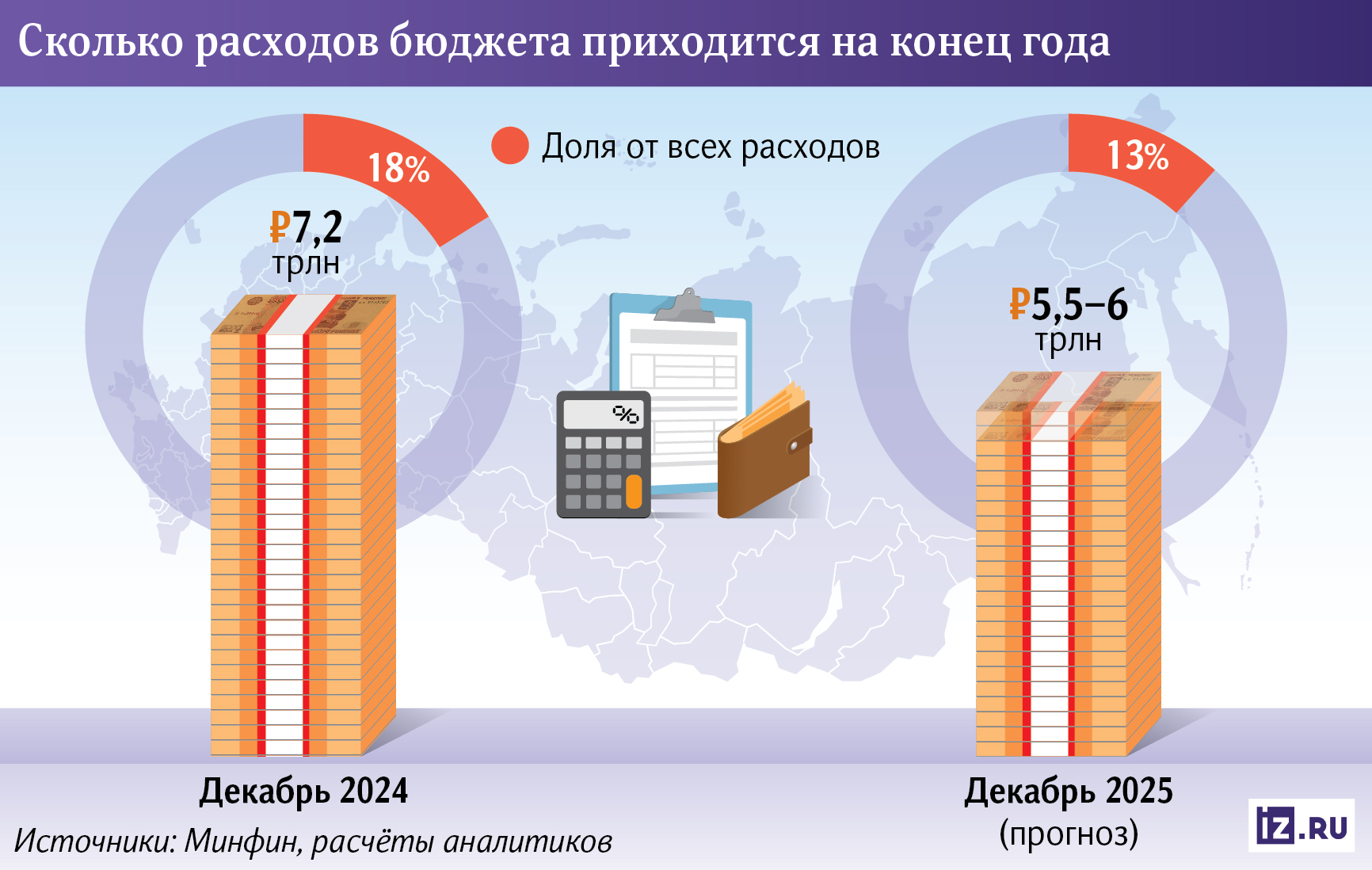
In December, the authorities will spend about 6 trillion rubles from the budget, or 13% of annual expenses, which is the lowest share since the early 2000s, calculated for Izvestia by the analytical company Euler. Usually, the last month accounted for significantly more expenses — up to a fifth of the budget plan. In an effort to reduce inflationary pressure, which traditionally increases by the holidays, the Ministry of Finance postponed a significant portion of spending to the beginning of the year. This made it possible to distribute the budget momentum more evenly. How such a strategy affects the business and the key rate is described in the Izvestia article.
How much money will the authorities spend at the end of the year
In 2025, the authorities were going to spend 42.8 trillion rubles. According to the preliminary estimate of the Ministry of Finance, 37.2 trillion has already been spent in January – November. If the agency meets the plan, it will account for about 5.5–6 trillion rubles in December, or only 13% of the total amount. This is the lowest share of December spending since the early 2000s. For comparison, in 2024, the last month accounted for about 18% of all expenses, and in some years the figure was close to 20%, calculated Elena Akhmedova, chief economist for Russia at Euler. Izvestia sent a request to the Ministry of Finance.
A feature of the budget policy of 2025 was a more even execution of costs during the year, instead of the traditional peak in the fourth quarter, said Olga Belenkaya, head of the Macroeconomic Analysis Department at Finam. This means that for most of the year, the volume of funded commitments was higher than in previous periods.
In nine months, treasury spending increased by about 20%. However, in the last quarter, the dynamics slowed down sharply: in October-November, according to the Ministry of Finance, expenses decreased by 8% year-on-year.
— A more even spending schedule throughout the year is a practice that the Ministry of Finance has long sought. This approach was also recommended by the auditors of the Accounting Chamber, but it was difficult to implement it earlier, including due to changes in the economic environment. In 2025, the agency finally managed to get closer to this model," Olga Belenkaya noted.

The budget momentum (the volume of net injections of government money into the economy) at the end of the year decreased due to active advances in early 2025, explained Elena Akhmedova.
The redistribution of budget spending shares between months may be due to several factors, said Natalia Milchakova, a leading analyst at Freedom Finance Global. Firstly, by the end of the year, the demand for imports decreased, which made the need for accelerated financing lower. Secondly, the Ministry of Finance could assume that, against the background of the risks of secondary sanctions, some partners from friendly countries are able to restrict or even stop the supply of certain products to Russia. Under these conditions, it was probably decided at the beginning of the year to purchase such products from foreign partners in advance, before the possible increase in restrictions, the expert believes.
— The postponement of budget expenditures to the beginning of the year looks like a sign of maturing financial policy. Moving away from the traditional December "blockage", when funds are hastily disbursed at the end of the year, makes the budget more calm and predictable for the economy. In fact, he ceases to be in a state of constant stress due to the need for urgent and often inefficient spending. This approach allows us to form a more sustainable budget structure," said Arthur Leer, Vice President of the Association of Exporters and Importers, Managing Partner of Lex Alliance Law Firm.
When funds are advanced in advance, they start working immediately: projects are launched, contracts are signed, and it becomes possible to plan rather than catch up with the calendar, he added. For businesses and regions, this approach means less tension and more resilience, and for the economy as a whole, a smoother rhythm without sharp distortions.
How does the budget affect inflation
The practice of a more even distribution of budget expenditures is an important step towards reducing inflationary pressure, said Fyodor Sidorov, a private investor and founder of the School of Practical Investment. As a rule, prices traditionally rise by the end of the year due to tariff indexation, premium payments, and preparations for the holidays.
— The mechanics here are as follows: when funds from the budget flow into the economy evenly throughout the year, the market manages to adapt, and there are no sharp spikes in demand. As you can see, an 8% reduction in budget spending in October-November compared to this period last year caused inflation to slow down to 6.6% in November after 7.7% in October. This is below the forecasts of the Central Bank, which creates space for further reduction of the key rate," the expert explained.
At the same time, for the real sector, the increase in budget spending on production is rather positive, as it gives industries access to financing at below-market rates, said Natalia Milchakova from Freedom Finance Global. According to her, the pro-inflationary effect of government spending is associated with an increase in the money supply, but consumer loans have a much stronger effect on prices: after receiving a loan, people spend money quickly. If the Ministry of Finance allocates funds to produce the necessary products, it helps to reduce the gap between supply and demand, which in the long run reduces inflationary pressure, the expert explained.
— Most likely, the more even execution of the financial plan will continue in the coming years. This fits into the government's policy of zero deficit and compliance with the budget rule. This approach reduces fluctuations in financial markets and helps the Central Bank to control prices more effectively with a key rate. This year's experience shows that coordinated actions of fiscal and monetary policy make it possible to slow down inflation without sharp shocks to the economy," said Arthur Leer from Lex Alliance.
Taking into account the latest weekly inflation data — 5.4% since the beginning of the year on December 15 — the price increase by the end of 2025 may be below 6%, with the Bank of Russia's forecast of 6.5-7%, believes Olga Belenkaya from Finam. According to her, the almost zero inflation in the first two weeks of December was unexpected, given the impact of the indexation of Russian Railways tariffs, changes in the VAT rate and the methodology for calculating scrap collection.
In September, the Ministry of Energy revised its macro forecast: against the background of a reduction in budget momentum, the department now expects a stronger slowdown in inflation — to 6.8% by the end of 2025 and to 4% in 2026.
Переведено сервисом «Яндекс Переводчик»
