- Статьи
- Science and technology
- Organic composition: scientists have found a possible "core of life" on Titan

Organic composition: scientists have found a possible "core of life" on Titan

Scientists have obtained new data that a large amount of ancient organic matter must exist in the core of Titan (Saturn's moon) — from 10% to 28% of the mass. These are simple hydrocarbons that could have formed during the formation of the Solar system. Together with the water ice, seas of methane and ethane that are present on Titan, they create conditions for the existence of life and make it the main candidate for the search for its extraterrestrial forms, the researchers believe. For more information, see the Izvestia article.
How scientists found organics on Titan
Scientists from the Vernadsky Institute of Geochemistry and Analytical Chemistry of the Russian Academy of Sciences (GEOHI RAS) have calculated the amount of organics in the composition of Titanium rocks. The results obtained led to the conclusion that this largest moon of Saturn may be the main candidate for the detection of extraterrestrial life in the Solar system. The Ministry of Education and Science of the Russian Federation told Izvestia about this.

As the researchers explained, this celestial body is currently the object of close attention of the scientific community. In particular, in 2004 it became an object for remote study by the Cassini probe. This mission, in particular, discovered seas and rivers of liquid methane and ethane on the surface of Titan, and also discovered the complex organic chemistry in its atmosphere. In addition, in January 2005, the Huygens spacecraft landed on Saturn's moon. It was used to take the first images from the surface of the satellite.
The next expedition to Titan, the Dradonfly interplanetary station, is expected to be launched in 2028. It will arrive on Sputnik after another six years.

According to Russian scientists, for a long time it was believed that Titan consists mainly of rock and water ice. However, its low average density, which is about 1.8 g/cm3, does not fit into existing models. Calculations have shown that if Saturn's moon consisted only of these components, it would be too heavy and would not correspond to real data.
— Numerical modeling has shown that in order to explain the observed parameters, a very large amount of light matter must be present in the composition of Titanium. These may be organics — complex carbonaceous compounds that are similar to terrestrial kerogens, bitumen, or bituminous coals," Anna Dunaeva, a researcher at the Laboratory of Thermodynamics and Mathematical Modeling of Natural Processes at the Russian Academy of Sciences, told Izvestia.

According to her, currently the most common view is that Titan has a separated rocky core and a water-ice shell with a vast subsurface ocean. According to calculations, in this model, the presence of a light organic component in the structure is a necessary condition. Moreover, such a stratification is possible if the Saturn satellite contains from 10 to 28% of this material (depending on which hard rocks it was originally formed from).
According to the researchers, the organic matter that became part of the rocks of Titan could have formed even at the stage of the formation of the Solar System, when interstellar dust and ice gathered into large bodies. It could also be delivered to the satellite using meteorites and comets.
What factors are needed for the appearance of life
As explained by Anna Dunaeva, the composition of the stony component with 20-28% of organic material is close to that of comets and is consistent with the composition of other icy moons and most objects in the Kuiper belt (the region of the Solar System beyond the orbit of Neptune. — Ed.). This suggests a genetic connection between cometary matter and the matter of regular satellites of giant planets, which, in turn, may indicate a common reservoir of precursor material in the outer Solar System.

— Space is not just a vacuum. This is a rather dusty environment, where tiny particles of organic matter could be formed under the influence of ultraviolet radiation, radiation rays and other factors. Or it could have arisen at the stage of the formation of the Solar System — on its outskirts, because organic matter does not tolerate heating well," the scientist noted.
At the same time, significant reserves of organic material, combined with the subglacial ocean of water, seas of methane and ethane that are present on Titan, make this celestial body the main candidate for the detection of extraterrestrial life, she said.

According to the researcher, organic molecules themselves remain lifeless, but water can play the role of a solvent and catalyst. In it, under the influence of various factors (radiation heating, gamma rays, energetic charged particles), reactions can occur that ultimately lead to the creation of living organisms. Saturn's moon, with its giant oceans under its icy crust and incredible reserves of organic matter, is a unique laboratory where all the necessary ingredients can be mixed in the right proportion.

The proposed hypothesis does not exclude the possibility of bringing life from Titan to Earth with the help of meteorites or comets, Anna Dunaeva added. Testing this theory is one of the objectives of the Dragonfly mission. The data obtained during the research can be useful in designing this expedition.
— The study of radiation spectra from distant molecular clouds in the interstellar medium has revealed more than 300 types of molecules. Including those that contain dozens of atoms. Most of them are organic compounds — carbon monoxide and methane, ethyl alcohol, amino acids, and others. They form solid matter — future asteroids and planets. An analysis of the composition of meteorites and asteroids showed that there was a huge amount of organic matter in the gas and dust cloud from which the objects of the Solar System were formed," Sergey Yazev, director of the Astronomical Observatory of Irkutsk State University, senior researcher at the Institute of Solar—Terrestrial Physics SB RAS, told Izvestia.

Therefore, the simplest organics were present on Titan from the very beginning, he explained. Then, chemical reactions could occur in the depths of the satellite at high pressures and temperatures, resulting in the formation of more and more organic substances. This suggests that Titan (like other large moons of giant planets) It could turn out to be a bioreactor, where some forms of life have formed over 3-4 billion years. However, according to him, this is still a hypothesis.
However, the scenario of transferring living organisms to Earth on comets does not violate the laws of nature, the expert added. However, even for her, this is a difficult engineering task. Do not forget that the young Earth itself was an ideal bioreactor with water, organic matter and energy.
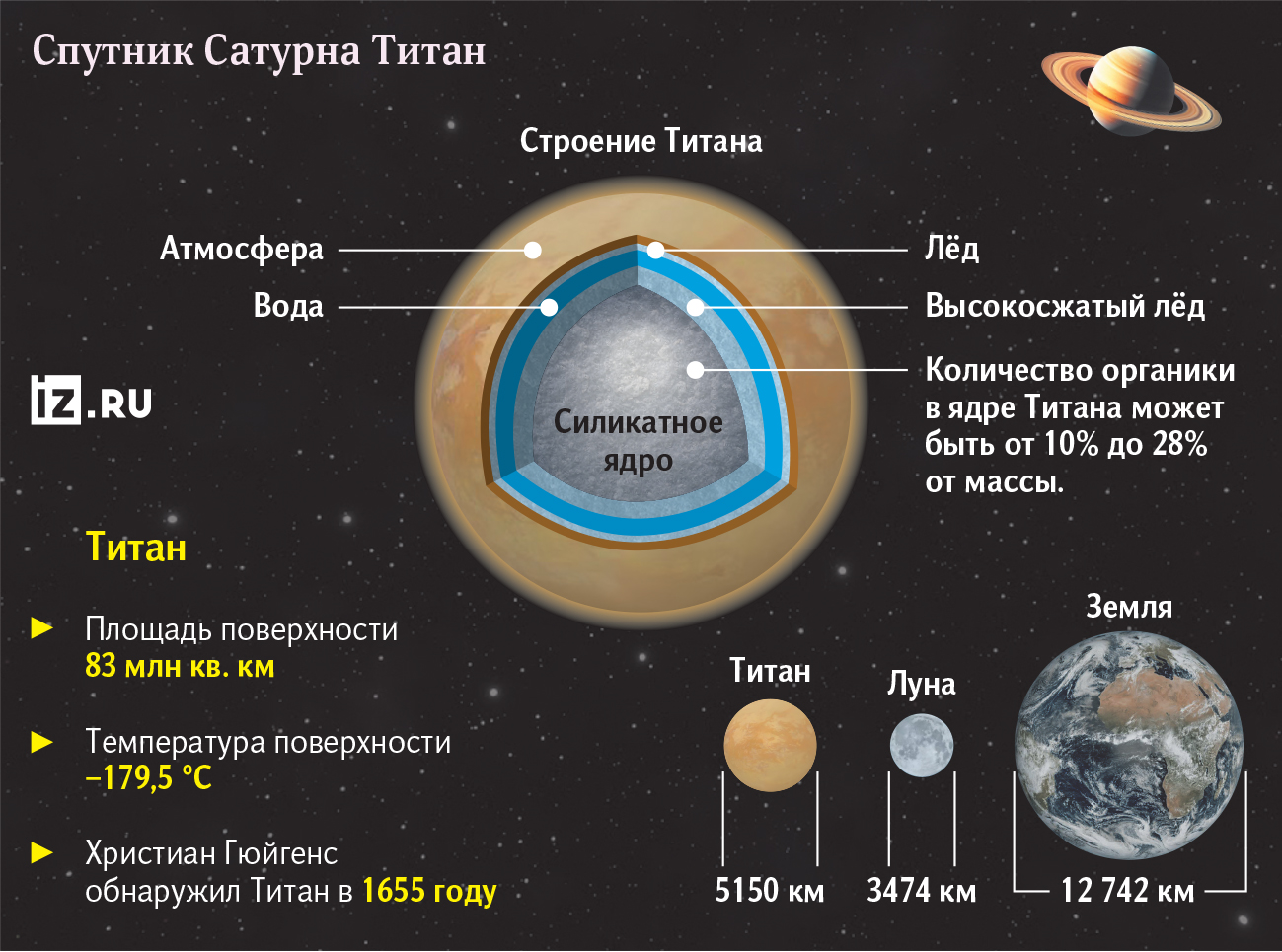
— Titan is the only body in the Solar system, except for Earth, where the existence of liquid on the surface is proven. In addition, in its dense atmosphere, complex organic molecules are synthesized from methane and nitrogen under the influence of ultraviolet sunlight and cosmic radiation. These compounds, falling to the surface, form a kind of "prebiotic broth" — a set of primary conditions for the formation of life, — explained Oleg Kotsyurbenko, an expert in space microbiology, professor at the Higher School of Ecology of Yugorsk State University.
He noted that two potentially habitable environments can be studied on Titan. The first is the surface, where active organochemistry with liquid methane as a solvent takes place at extremely low temperatures. The second is the subglacial water—ammonia ocean, where conditions may be similar to those on Earth. At the same time, the problem may be the lack of available organic matter and energy. But if, as the researchers claim, the core of Saturn's moon is enriched with organic compounds, they can enter the ocean through hydrothermal vents.
Переведено сервисом «Яндекс Переводчик»
