- Статьи
- Economy
- They lived and sold: second-hand goods fell in price in a third of Russia's regions at once

They lived and sold: second-hand goods fell in price in a third of Russia's regions at once

Secondary housing has fallen in price in a third of the country's regions. In the second quarter, the Central Bank recorded a decrease in the average price per square meter in 27 regions of the Russian Federation (Izvestia analyzed the regulator's data). The strongest is in the Kaluga and Murmansk regions, as well as in the Krasnodar Territory. The Magadan and Tver regions are also on the list. The unavailability of a market mortgage forces sellers to reduce the cost in order to make their offer more competitive and speed up the sale. In addition, new quarters are more interesting to buyers than an outdated fund. At the same time, the supply of apartments in such buildings on the market has already increased by 20%. Whether this can lead to problems for developers who will not be able to sell housing in new buildings is discussed in the Izvestia article.
Which housing is getting cheaper in 2025
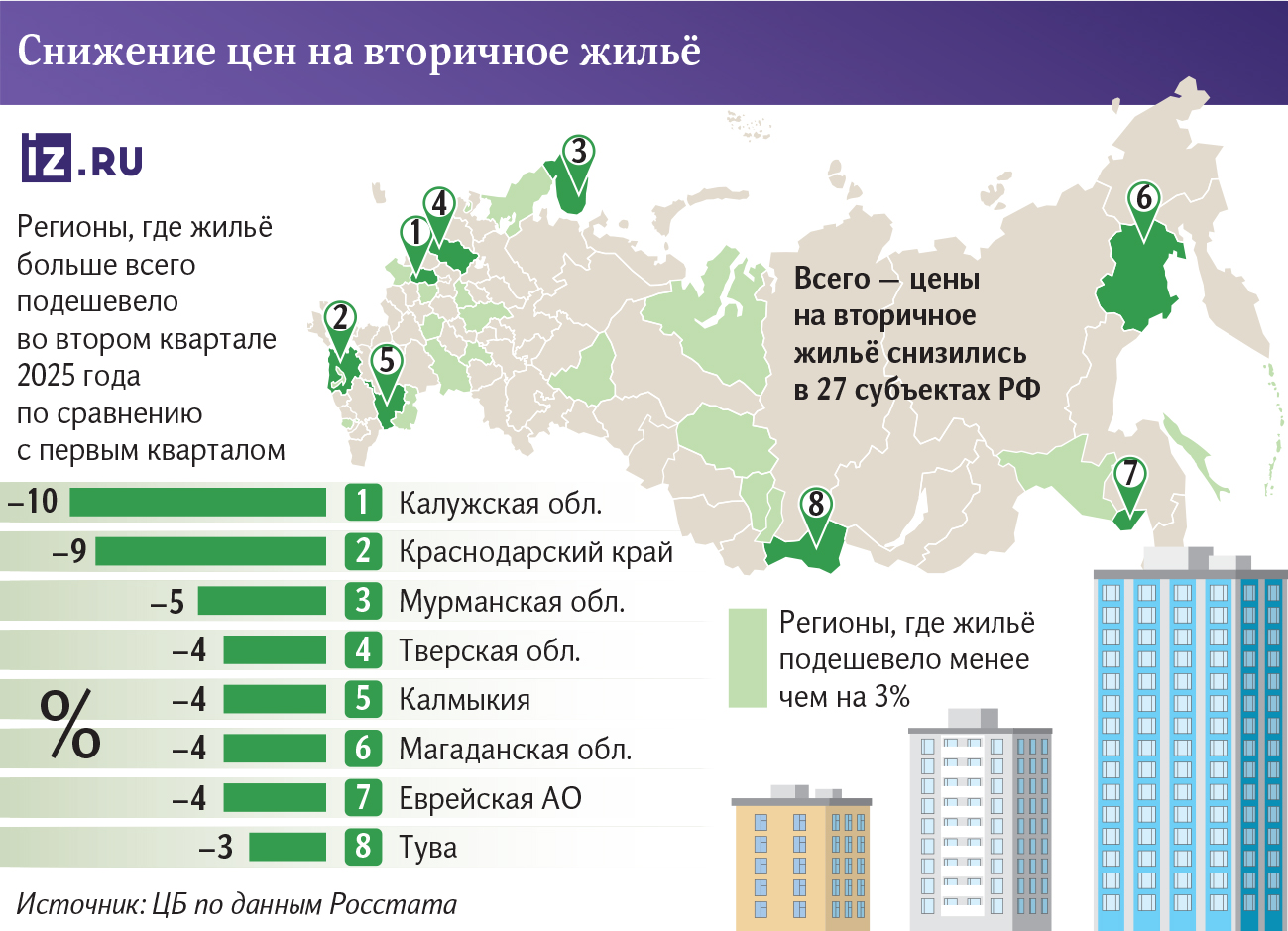
In Russia, secondary housing began to become cheaper — the average price per square meter fell immediately in a third of the country's regions. In April – June of this year, compared to the first quarter, the cost decreased immediately in 27 of the 83 regions for which data are available. This follows from the statistics of the Central Bank, which was studied by Izvestia.

The price fell the most in the Kaluga region — the average cost per square meter dropped by 10%, to 92 thousand. The decrease in the Krasnodar Territory was only slightly less — by 9%, to 175.5 thousand. Housing has fallen in price by 5% in the Murmansk region (up to 84 thousand per square meter). Next on the list are the Tver Region, the Eastern Administrative District, the Republics of Kalmykia and Tyva.
The price for the second quarter also dropped, for example, in St. Petersburg, Adygea, Karelia, Astrakhan and Nizhny Novgorod regions and in North Ossetia, follows from the data of the Central Bank. Among the cities with millions of residents, the average cost per square meter of secondary housing has decreased most significantly in Nizhny Novgorod, Chelyabinsk, Omsk and Rostov-on-Don, added Sergey Zaitsev, sales Director of the federal company Floors.
No matter what happens, prices are rising in Moscow and the Moscow region. Even for the secondary market, the average cost per square meter in the second quarter increased by 5 and 1% (to 376.7 thousand and 171.8 thousand, respectively).
At the same time, there was no such noticeable downward trend in prices across the country last year. Then, over the same period, secondary housing fell slightly in only 11 regions out of 83, as can be seen from the statistics of the Central Bank.
The massive decline in prices on the secondary market this year is primarily due to weak demand in certain regions against the background of too high lending costs. The fact is that preferential mortgages do not apply to secondary mortgages, and the key ones at that time were mostly at a record high of 21% per annum, explained Vladimir Chernov, analyst at Freedom Finance Global. Therefore, demand has been redistributed in favor of new buildings. Only in June, the Central Bank lowered the rate to 20%, and then, in July, it lowered it to 18%.

Against the background of such rates, sellers understood that the demand for the purchase of apartments in the secondary market is now extremely small, because mortgages for buyers of such housing are virtually unavailable. This forced them to lower housing prices if they needed to sell it as soon as possible, without expecting a reduction in the Central Bank's rate.
If we analyze transactions in the secondary housing market in Russia, then, according to Roskadaster, 739.8 thousand apartment purchase and sale agreements were concluded in the first half of 2025, which is 9% lower than in the same period of 2024, Avito Real Estate told Izvestia. One of the key reasons for the decline remains the high level of market mortgage rates. The share of mortgages in transactions on the secondary market in the first six months of this year was only 23% compared to 34% a year earlier.

In the second quarter, several factors coincided at once, which led to lower prices, Vladimir Chernov continued. Firstly, mortgage demand has shifted in favor of the primary market. Housing, on the contrary, has become more expensive there due to preferential programs in a number of regions. Secondly, the previously accumulated effect of price adjustments after the rapid growth in previous years has affected. Sellers first held the price, and then began to lower it.

In a number of regions, a decrease in investment attractiveness is also having an impact, says Evgeny Shavnev, CEO of the Flip real estate investment company. For example, in the Krasnodar Territory, the situation of increased danger overlapped with an environmental disaster. In addition, there is still an outflow of population in the regions and, as a result, an increase in the number of objects for sale and the desire of sellers to quickly sell real estate, the expert noted.
The largest drop in prices is recorded in regions with a pronounced imbalance of supply and demand, added Valery Tumin, Director of Markets in Russia and the CIS at fam Properties. For example, the Krasnodar Territory has become a leader in housing construction in recent years, and new neighborhoods are actively competing with outdated housing stock. In northern regions, such as the Magadan Region, as well as in small districts like the EAO, demand is traditionally limited, and prices adjust faster as supply increases.
Are there any risks of a large-scale crisis in the new building market
The average bidding level in July-August set another record, reaching 6.5%, added Sergey Zaitsev from the Floors company. In addition, since January of this year, the volume of supply on the secondary market has been steadily growing and has already increased by 18-20%.
Lower prices on the secondary market increase the affordability of housing for the population, said Valery Tumin from fam Properties. Many families who could not afford to buy in previous years are now getting this opportunity.
However, this also leads to an increase in the price gap between the primary and secondary markets. In Central Russia, it has already reached 80%, Izvestia wrote earlier.

Developers are still supported by government mechanisms, which allows them to keep prices in new buildings at a relatively high level, explained Maxim Lazovsky, owner of the Lazovsky House construction company. The secondary market was left without such protection, and it was there that competition for a few buyers intensified. Hence the growing cost gap: new buildings are getting more expensive or, at best, holding the bar, while secondary housing is getting cheaper.
For buyers with their own savings, this opens up new opportunities, but for those who sell an apartment to buy housing in a new building, the risks only increase, the expert emphasized.

— The collateral profile is changing for banks and mortgage programs (different discounts, risks in the assessment). And there is a macro-level risk, since if the secondary market remains illiquid in certain regions for a long time, this puts pressure on consumer expectations and may increase price correction in the primary chain. Developers may slow down sales or commissioning," admitted Vladimir Chernov.
Currently, apartments that have decreased in price or those where the owners are ready to bargain are being purchased on the secondary market, so the real sale price may fall by another 3-4% by the end of the year, Sergey Zaitsev predicts.

Lower prices in the secondary market and the remaining discount with a further increase in the availability of market mortgages (due to lower key mortgages) will lead to a flow of buyers from primary housing to ready-made housing and complicate the situation with the sale of apartments in new buildings. Against this background, prices in the secondary market may return to growth again following the recovering demand, the expert warned.
Evgeny Shavnev from Flip agreed with this. He explained that when pricing in the primary housing market, the cost of construction is important, which makes it much more difficult for developers to play with prices. Therefore, there is a risk that they may face a certain outflow of customers. However, the expert believes that this will not lead to a massive crisis as long as preferential programs are in effect.
Переведено сервисом «Яндекс Переводчик»
