Stratosphere of influence: frequent rocket launches can destroy the ozone layer in 25 years
- Статьи
- Science and technology
- Stratosphere of influence: frequent rocket launches can destroy the ozone layer in 25 years


A significant increase in rocket launches caused by the development of the near-Earth economy is thinning the ozone layer, scientists have found. If there is an unfavorable development of events by 2050, the consequences will be irreversible. The regions of southern Russia may also be at risk. Experts have proposed a set of measures to restore the ozone layer. This includes limiting the use of rocket fuels that contain chlorine, and introducing regulations and quotas. However, according to experts, the United States may use these measures to limit competition in the field of rocket launches.
What substances affect the ozone layer
The development of space technologies can negatively affect the state of the ozone layer, the protective shell of the Earth that protects all living things from aggressive UV radiation. This conclusion was reached by scientists from St. Petersburg State University, who, together with colleagues from New Zealand, the USA, Switzerland and Spain, modeled the effect of rocket launches on the ozonosphere.
According to the researchers, in recent years, the number of systems in near-Earth space that provide satellite Internet, navigation, Earth sensing and other services has increased significantly. Such systems consist of thousands of vehicles located in orbits at altitudes from 250 to 600 km. To maintain their performance, they require constant updating and replacement of individual satellites, which leads to frequent rocket launches. As a result, the stratosphere is experiencing unprecedented stress.
— Many gases and solid particles that are formed during the operation of rocket engines have high chemical and radiation activity and are capable of destroying the ozone layer. Moreover, this effect occurs both during launches and during the return of spacecraft to the atmosphere," Evgeny Rozanov, co—author of the study and head of the Laboratory for Ozone Layer and Upper Atmosphere Research at St. Petersburg State University, told Izvestia.

All types of fuels create emissions that affect the ozone layer, he said. For example, the combustion of kerosene generates carbon dioxide, water vapor, nitrogen oxides and soot. And when burning solid rocket fuels, particles of alumina (aluminum oxide) and hydrogen chloride are added to them. The latter quickly turns into reactive chlorine.
The greatest damage to the ozone layer is caused by chlorine and nitrogen compounds, which directly destroy it as a result of chemical reactions, the scientists noted. However, water vapor contributes to the formation of aggressive compounds, and aluminum oxide particles act as a catalyst, accelerating these processes.
Substances that are formed during the descent of spacecraft from orbit and their return to the atmosphere are also of concern. In particular, aluminum oxide particles ablate (blow off) from the surface of objects in the upper atmosphere. As a result, about 0.2–5 thousand tons of these substances per year can accumulate in the stratosphere.
Which regions may be at risk?
— To understand whether ozone losses occur with the development of the rocket and space industry, we considered two scenarios until 2030 — ambitious and conservative. In the first case, launches take place at 72-hour intervals at each of the 17 operating spaceports, which implies 2,040 launches per year. The second scenario is one per week and, therefore, 884 launches per year," explained Evgeny Rozanov.
According to him, the ozone layer is restored by 1-3% on average in 10 years. However, in five years, it will lose 0.17% annually under a conservative scenario, and 0.29% under an ambitious one. This means that the protective barrier of the planet will thin out. The current pace of issuing launch licenses suggests that the minimum scenario will be significantly exceeded.
Scientists suggest that the strongest thinning of the ozone layer — up to 4% — will occur in the high latitudes of the southern hemisphere — over New Zealand and South America. If the trends continue, irreversible changes will occur in these areas by 2050. With further developments, these phenomena will spread to the Northern Hemisphere, including southern Russia.
It is impossible to abandon rocket launches, since the development of technology and the exploration of outer space depend on them. However, it is possible to reduce their negative impact by reducing the use of solid fuels with chlorine content, Evgeny Rozanov believes. Another measure may be the introduction of regulation and quotas.

What impact do Starlink satellites have on the ozone layer?
— For example, SpaceX's Falcon-9 rocket launches do have an impact on the Earth's ozone layer. The main threat is posed by emissions of nitrogen oxides and metal particles. Particles are also dangerous. The fuel for the Starship launch vehicle, methane, is relatively environmentally friendly. When it burns, water and carbon dioxide are released. Nevertheless, in large doses at altitudes above 90 km, they can affect chemical processes in the atmosphere, and regular, frequent launches can enhance the effect," commented Nicholas Oxman, an expert in cosmonautics and author of the Cosmodiver Telegram channel.
He added that the ozone layer is capable of self-healing due to sunlight. And the current scale of rocket launches will not lead to its catastrophic destruction. But the prospect of a sharp increase in launches and the burning of thousands of satellites is alarming. So far, Starship launches have had a local and reversible impact, but at the pace of launches that Elon Musk promises in the case of his Mars program, this may become a problem for Earth.
— In the study, scientists drew parallels with the situation in the 1970s and 1980s, when the massive use of refrigerants such as freon led to a severe thinning of the ozone layer. The critical situation was rectified thanks to the Montreal Protocol of 1987, which united the world community to phase out the use of hazardous substances. Today, according to scientists, rocket launches can reverse the recovery process," said Igor Ugolnikov, senior researcher at the Space Research Institute of the Russian Academy of Sciences.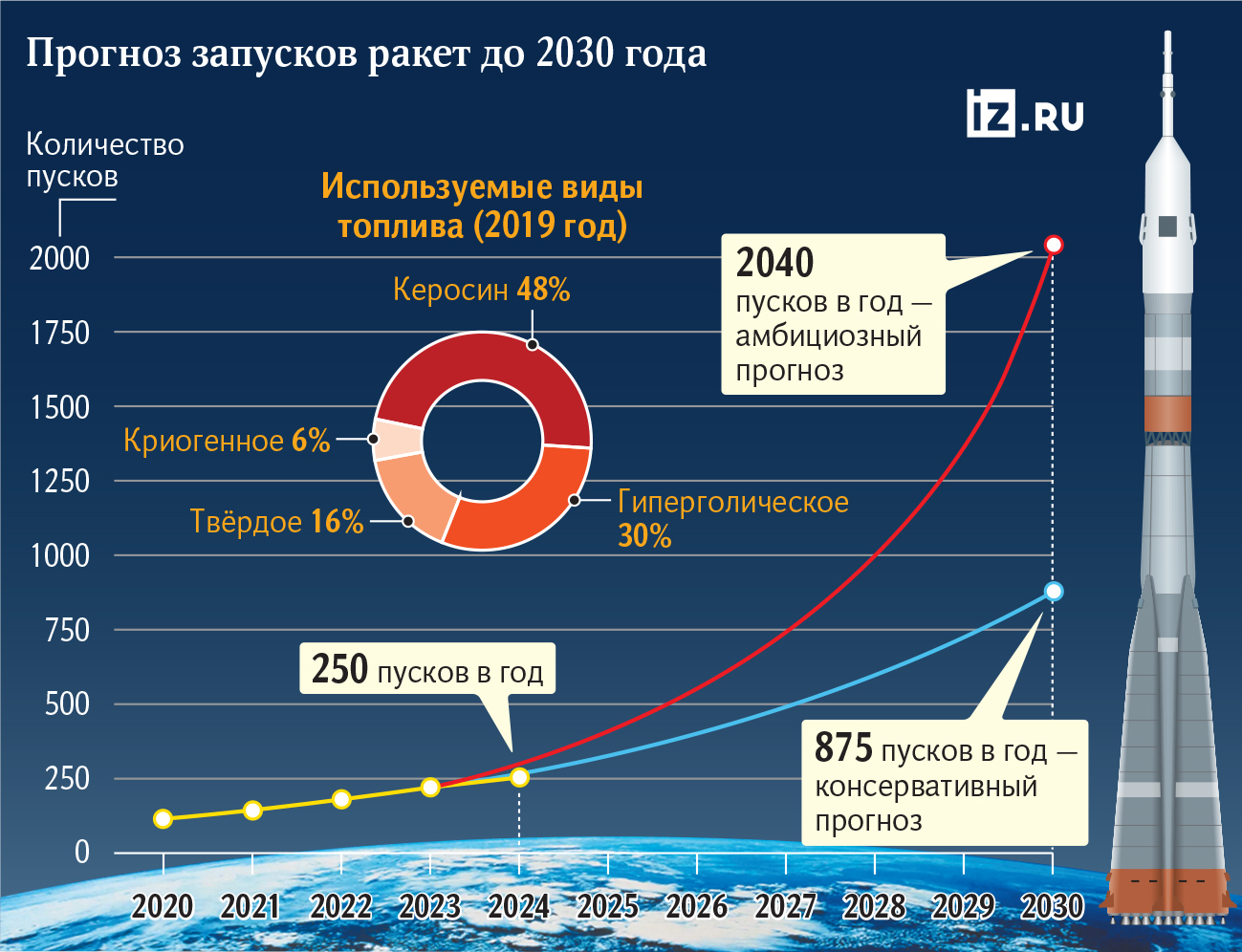
However, according to Yuri Yasyukevich, a leading researcher at the Institute of Solar-Terrestrial Physics of the Siberian Branch of the Russian Academy of Sciences, small chemical impurities that appear in the upper atmosphere can change its overall photochemistry. This can provoke an imbalance, the consequences of which are difficult to predict.
— The scientific work is based on the well-known photochemical model of the Sokol atmosphere of Russian origin. The authors come to the obvious conclusion that the space industry affects the composition of the atmosphere on a global scale. At the same time, it is doubtful that anyone other than experts will feel this influence, since we are talking about a change in the concentration of stratospheric ozone by units of percent. However, if the number of launches increases, the effect will become significant in a few decades," says Alexander Rodin, Executive Director of the Scientific and Technical Center for Environmental Monitoring and Ecology at MIPT.
International regulation is likely to be tightened in the coming years, he suggested. In particular, restrictions will be imposed on the composition of rocket fuel. At the same time, the United States can use concern for the ozone layer as an excuse to maintain its leadership in the space business and prevent competitors from entering the market, the expert concluded.
Переведено сервисом «Яндекс Переводчик»
