- Статьи
- Science and technology
- Vostok is a delicate matter: a DNA protein and an artificial tooth with sensations

Vostok is a delicate matter: a DNA protein and an artificial tooth with sensations

In Russia, chemical scientists have discovered the secret of fading blue paint on ancient paintings, which will help restore masterpieces of painting, and dentists from the United States have developed artificial teeth that grow into the gum tissue themselves and connect to the nervous system. Engineering researchers have accelerated quantum algorithms for multi-qubit computers, and materials scientists have figured out how to produce wires several nanometers thick. Biologists have found a protein that is responsible for laying the DNA helix in neurons. It was named Vostok, in honor of the first manned spacecraft. Studying this structure will help to create methods for the treatment of hereditary nervous pathologies. For more information, see the selection of the most interesting science news prepared by Izvestia.
Ultrathin wires will help make chips the size of a molecule.
Scientists from NUST MISIS, Tulane University (USA) and Suzhou University of Science and Technology (China) have developed a method for producing ultrathin crystals with semiconductor properties. Their thickness ranges from 100 to 400 nm, and their length is several millimeters. Due to these parameters, they can perform the functions of wires for ultra-miniature electronic devices.

The new materials relate to one-dimensional structures. According to experts, the samples obtained demonstrated stability and resistance to moisture and sunlight.
— The crystals are based on tantalum, nickel and selenium compounds. Unlike similar developments, where the starting powders are located at one point of the ampoule, the new method assumes their uniform distribution over the inner surface by means of electrostatic charging. Then the ampoule was heated, as a result of which the thinnest crystalline filaments formed on its walls," Konstantin Larionov, a researcher at the NUST MISIS Laboratory of Digital Materials Science, described the technology.

As scientists have found out, crystals can be split into even finer structures — up to 7 nm. This opens the way for the development of electronic circuits on a single nanowire. Such devices, for example, can be used as part of smart products, where sensitive artificial receptor molecules will change their electrical properties upon contact with target substances.
Russian engineers have accelerated the transfer of quantum information
Researchers from ITMO and the London Institute of Mathematical Sciences have proposed a method that will increase the speed of quantum algorithms in multi-qubit computers.
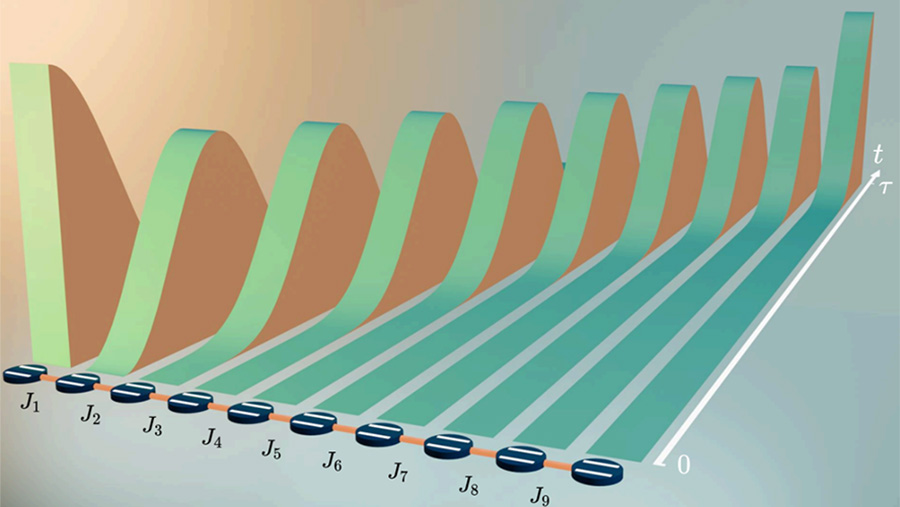
As the developers explained, advanced computers of this type already use more than a thousand qubits (units of information in quantum systems). Therefore, managing them becomes a difficult task. However, physicists have found a way to transfer the data encoded in their quantum states between qubits at maximum speed.
— The significance of the work lies not in solving specific problems, but in developing a new method suitable for large quantum systems. This will allow us to find more efficient algorithms, prepare quantum states faster, and generally expand the capabilities of modern systems," explained Maxim Gorlach, a leading researcher at ITMO.
To transfer the excitation in a chain of qubits, the scientist said, an idea was proposed similar to the classical physical problem of the fastest trajectory along which a ball rolls between two points. So, in the quantum computing algorithm proposed by scientists, the connection between the first two qubits is more strongly activated at the start. Then it weakens while longer-range connections "gain strength."
As a result, the state is exactly transferred from the first qubit of the chain to the last one. The new protocol reduces the number of logical operations and, consequently, possible errors.
Chemists have discovered the secret of fading blue paint in masterpieces of painting
Scientists from the Vinogradov Institute of Geochemistry SB RAS and the Institute of the Earth's Crust SB RAS together with colleagues from Bar-Ilan University (Israel) We found out why ultramarine, a dye that used to be often used to create paintings and frescoes, is losing its brightness.

"Our research will make it possible to create paints based on natural lapis lazuli pigment that are resistant to fading under the influence of air and high temperatures," said Vladimir Tauson, project manager, chief researcher at the Laboratory for Modeling Geochemical Processes at the IG SB RAS.
Scientists compared mineral samples from deposits in the Baikal region with different grain sizes, keeping them for eight hours at a temperature of 800 ° C. As a result of the experiment, small particles were partially or completely discolored, while larger ones darkened and acquired a purple hue.

According to experts, this happens because in large grains, calcium carbonate (one of the impurity components) maintains a balance between oxidized and reduced forms of sulfur. Due to this, the samples did not lose their color.
Protein for DNA folding can improve brain function
Biologists from the Institute of Gene Biology of the Russian Academy of Sciences and Princeton University (USA) have identified a previously unknown protein in the nuclei of fruit fly brain cells, which is involved in the three-dimensional folding of DNA molecules. This is important because proper stacking allows neurons to develop and form connections with each other.

As the researchers explained, they found a short repeating sequence in the genome using computer analysis. Moreover, it is more common in areas that are presumably involved in the formation of loops. It turned out that a previously unknown regulatory protein was associated with it. Schematically, it is depicted as an arc, which is similar to the trajectory of missiles. Therefore, the open molecular structure was named Vostok, in honor of the first manned spacecraft.
"Understanding how loops form in the DNA molecule opens up new possibilities for gene therapy. For example, by establishing how to control looping, in the future we will be able to adjust the work of genes in hereditary diseases of the nervous system," said Maxim Erokhin, head of the chromatin biology group at the Institute of Gene Biology of the Russian Academy of Sciences.

Dentists have created an artificial tooth with natural sensations
An artificial tooth that grows into the gum itself and connects to the human nervous system was created by scientists from the School of Dental Medicine and Tufts University School of Medicine (USA). At first, its size is smaller than the natural organ, but then it grows and stands flush with the rest of the teeth.

According to the developers, the implant consists of a layer of rubber nanofibers, which expand as the shell biodegrades. As a result, they fix the artificial tooth in the soft tissue lining the hole, rather than in the jawbone, like traditional ceramic crowns mounted on titanium pins.
— Natural teeth connect to bone through soft tissue rich in nerves that help us sense pressure and texture and determine how we chew and speak. The implants lack this sensory feedback," explained the study's lead author, Jake Jinkun Chen, a professor of periodontology at the School of Dental Medicine.
According to him, after the experiment, the visualization showed the presence of free space between the implant and the bone, which suggests that the implant was integrated into soft tissues, rather than fused to the bone in the traditional way.
The next step is to test the technology on large sets of teeth from model animals, and then on humans, the professor said.
Переведено сервисом «Яндекс Переводчик»
