- Статьи
- Economy
- Mistake 500: How will the idea of imposing duties on Russian oil importers affect the global economy

Mistake 500: How will the idea of imposing duties on Russian oil importers affect the global economy
The bill, which provides for the introduction by the United States of 500 percent duties on importing countries of Russian oil and gas, could lead to a new trade war and the collapse of the American economy. This opinion is shared by industry experts interviewed by Izvestia. Such a move would put an end to trade with India, China, Turkey and other BRICS representatives, which is unlikely. At the same time, the bill becomes an important lever for Trump to exert political pressure. For more information, see the Izvestia article.
Sanctions against Russia
The new bill, if passed, will give US President Donald Trump the opportunity to impose 500 percent duties on importing countries of Russian oil and gas. This was announced by Senator and author of the initiative to tighten restrictions Lindsey Graham (listed as a terrorist and extremist by Rosfinmonitoring).
"If you buy goods from Russia and do not help Ukraine, a 500% duty will be imposed on your shipments to the United States. India and China buy 70% of [Russia's] oil <...>, [this bill] will allow the president to impose duties on China, India and other countries," he said in an interview with ABC News.

He stressed that this initiative is supported by the American leader Donald Trump.
"For the first time, the president told me when we were playing golf that it was time to promote the bill," the politician said on June 29.
According to him, this initiative is supported by 84 senators, the congress will begin to develop new measures after a break in July, starting on the 7th.

The bill allows the American president to impose such sanctions, but does not oblige him to do so, said Igor Yushkov, an expert at the Financial University and a leading analyst at the National Energy Security Fund.
— If Trump wanted to impose sanctions, he would have done so by presidential decree. A separate bill is not needed for this," he said.

US President Donald Trump
Ekaterina Kosareva, Managing Partner of VMT Consult, agrees with her colleague. She recalled that Donald Trump did not support the G7 initiative to lower the ceiling on Russian oil prices from $60 to $45 per barrel.
— If Trump had a desire to put pressure on Moscow now, he would have agreed with the proposals of his European colleagues. But he understands that this step would lead to an increase in oil prices, which he has been actively fighting lately. And the imposition of duties against countries importing Russian energy resources can lead to a huge increase in prices for hydrocarbons around the world," she believes.
The bill on the introduction of duties of 500% for countries trading with the Russian Federation
More recently, Donald Trump explained the absence of tariff threats towards Russia by his unwillingness to disrupt the negotiation process on Ukraine, which was launched with such difficulty with the direct participation of Washington. Against this background, the introduction of duties of 500% contradicts the rhetoric of the administration since the beginning of its work in the White House.
— Blackmail over sanctions is a lever of pressure on Russia. These conversations are a typical game of good cop and evil cop, with senators acting as the evil one and the Trump administration as the kind one. They are putting pressure on Russia, demonstrating that if it continues to be uncompromising on the issue of the truce in Ukraine, then hypothetically the Trump administration may resort to this sanctions tool. But in reality, the probability of such a development, which we have only heard from senators, is extremely low. There were no specific statements directly from representatives of the White House or the State Department," Dmitry Suslov, deputy director of the Center for Comprehensive European and International Studies at the Faculty of World Economy and World Politics at the National Research University Higher School of Economics, tells Izvestia.

Just a few days ago, on the sidelines of the NATO summit, Secretary of State Marco Rubio said that if the United States "crushed" Russia with sanctions, "the window for negotiations with the Russian Federation would probably close." At the same time, the head of the State Department added that Trump "knows when the right time and place will be" for new restrictive measures against Russia.

The potential bill also contrasts with the specific steps taken by the American administration and threatens other geopolitical losses. The Donald Trump administration has just concluded an interim trade agreement with China and is close to concluding an agreement with India, Russia's BRICS and SCO partners. In both cases, it is unprofitable for Trump to destabilize the situation.
— Let's say they want to impose sanctions on India as well. But this country acts as a counterweight to China. And here, at the same time, they are putting pressure on India, forcing it to consolidate with Russia on an anti—American basis," Konstantin Blokhin, a leading researcher at the Center for Security Studies at the Russian Academy of Sciences, told Izvestia.

In addition, the Americans have just lifted sanctions on the construction of the Paks-2 nuclear power plant in Hungary with the participation of Rosatom. Back in November 2024, the administration of former US President Joe Biden imposed restrictions on Gazprombank, through which the project was financed. "Fortunately, since January, the president [Donald Trump] has appeared at the White House in Washington, who sees Hungary as a friend. Based on this, the US government lifted sanctions on investments in the Paks nuclear power plant," said Hungarian Foreign Minister Peter Szijjarto.
Trade wars and rising prices
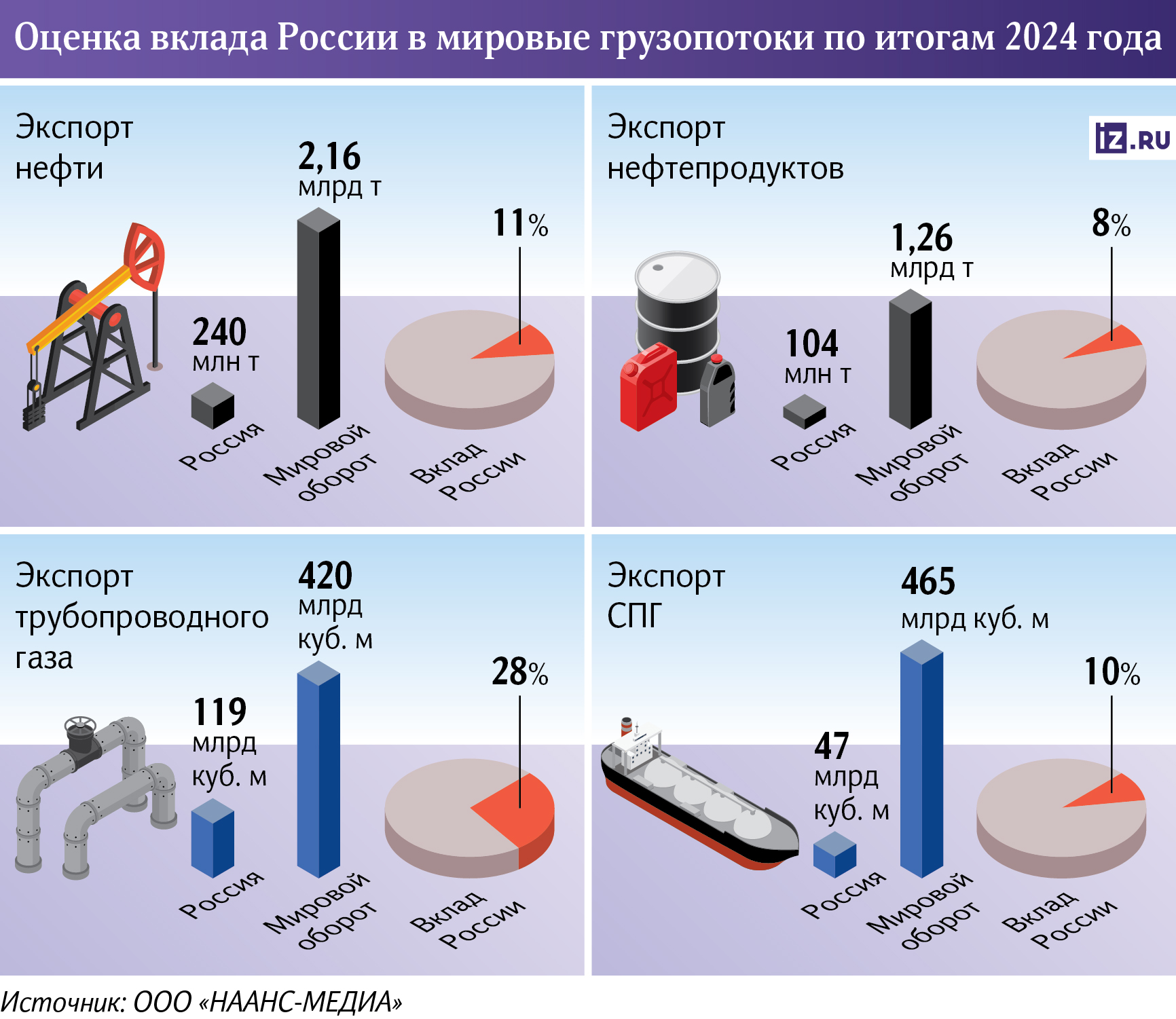
Tamara Safonova, General Director of the Independent Analytical Agency of the Oil and Gas Sector LLC (NAANS-MEDIA LLC), believes that a five-fold increase in customs duties will lead to buyers of Russian hydrocarbons ceasing trade with the United States, as well as to a new round of supply chain transformation, while the products of these countries will find their buyers on alternative friendly markets.
According to her estimates, the share of Russian exports in global oil supplies is 11%, pipeline gas — 28%, and LNG — 10%.
"If we hypothetically assume that as a result of the US trade policy, Russia will simultaneously stop supplying oil and gas to world markets, then there will be a collapse inversely proportional to covid, when the demand for oil on world markets has collapsed by a quarter," she said.

According to her, among other things, there will be a reduction in production in importing countries of refined petroleum products from it and further along the petrochemical chain. The global economy is in a fever from loud and often contradictory information from the United States regarding trade policy, which "primarily affects the slowdown in economic growth in the States themselves," the expert added.
"The US customs policy has already led to a disruption of trade relations, an aggravation of the economic downturn, a decrease in production performance and a depreciation of the US currency," Tamara Safonova emphasized.

Valery Andrianov, an associate professor at the Financial University under the Government of the Russian Federation, also believes that the presented initiative is "too fantastic to be perceived as real."
— Let's say the United States imposes such a duty, but China will continue to purchase Russian oil. And what will happen? Will all trade relations with China be terminated immediately? How many months will the American economy survive after that? In addition, the United States is now close to signing a trade agreement with China, and therefore it would be unwise to quarrel with Beijing again over Russian oil. The same applies to India, which has warmer relations with the United States than China. It is unlikely that Washington will want to break off cooperation with New Delhi because of Russian raw materials," he said.

Sergey Tereshkin, CEO of Open Oil Market, added that the senator's project would de facto mean the imposition of prohibitive import duties on Turkey, which is not only the largest importer of petroleum products from Russia, but also plays a crucial role in resolving conflicts in the Middle East. The United States is unlikely to escalate relations with the republic.
 Thus, the proposed law will either not be adopted or will not be implemented, Valery Andrianov believes. According to him, many Western sanctions have already suffered a similar fate. Being "scary" in form, they are absolutely "toothless" in their content, he concluded.
Переведено сервисом «Яндекс Переводчик»
