- Статьи
- World
- The Hague series: NATO talks about unity amid the split between Europe and the United States

The Hague series: NATO talks about unity amid the split between Europe and the United States
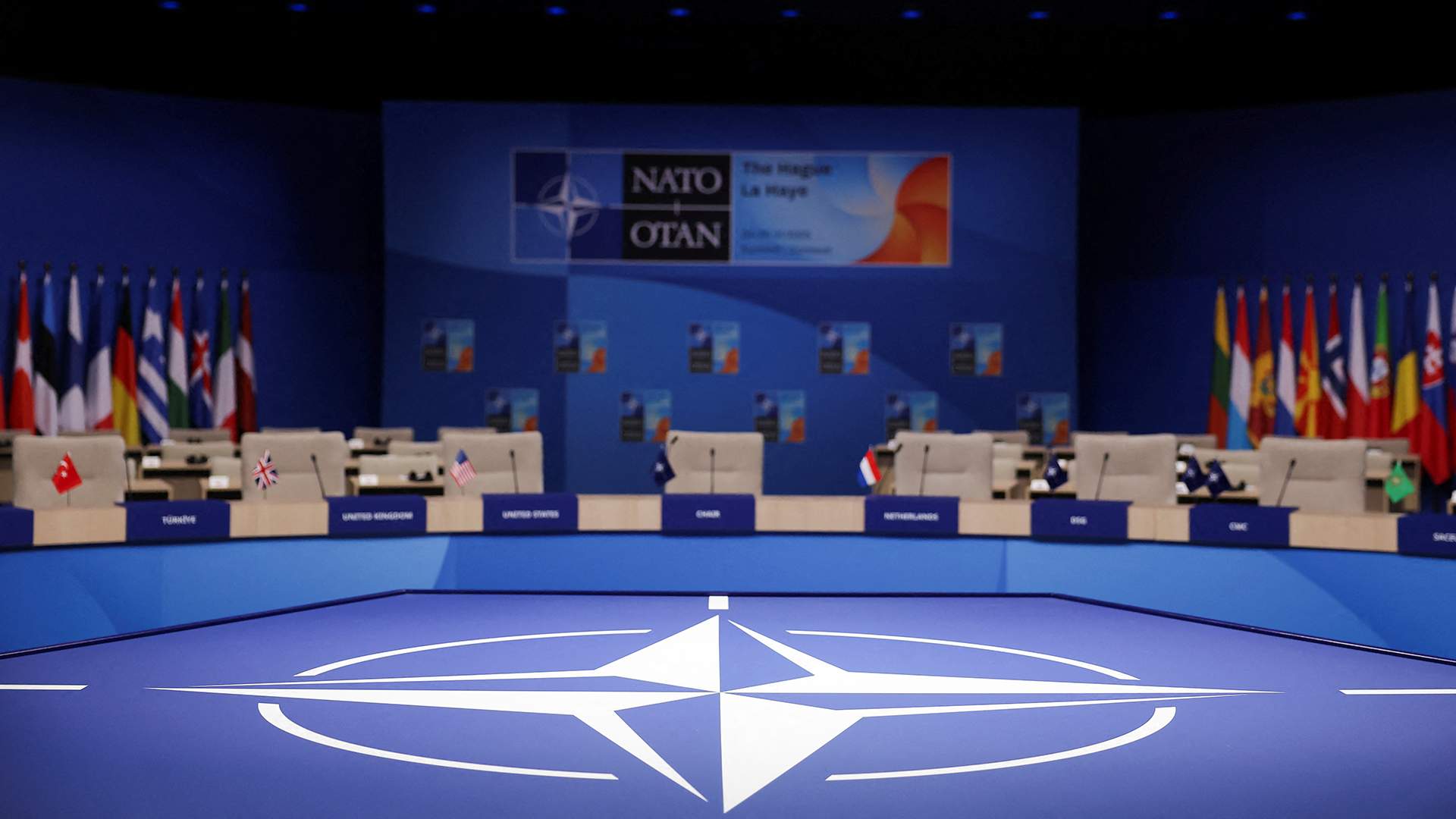
The American administration is seriously at odds in its approaches to supporting Ukraine with European countries, Rodion Miroshnik, the Russian Foreign Ministry's ambassador-at-large for crimes committed by the Kiev regime, told Izvestia. On June 24, the two-day NATO summit kicked off in The Hague. Vladimir Zelensky is counting on a meeting with Donald Trump, expecting to receive more military assistance. But Americans do not see any pragmatic sense for themselves in maintaining the conflict. The key point of the meeting of the leaders of the bloc's states is to reach an agreement on increasing military spending to 5%. However, the expert community believes that the real commitment of the alliance's members to the new plan is questionable — additional defense spending can be funded by the social sphere. About how the NATO summit is taking place and whether the topic of the escalation of the conflict between Iran and Israel was discussed is in the Izvestia article.
NATO's support for Ukraine
The first day of the NATO summit has ended in The Hague. It was held quietly, without scandals — this is exactly what the organizers expected, for whom it was important to demonstrate the unity of the alliance against the background of the deepening split between Europe and the United States. The key problem of the bloc remains the willingness of the Americans to continue military support for Kiev against the background of the dialogue between the United States and the Russian Federation on Ukraine.

The alliance was on the verge of collapse after the re-election of Donald Trump as president of the United States, and overall, NATO is experiencing the most dangerous crisis in 75 years, Bloomberg is sounding the alarm. Although, on his way to the summit, the American president wrote conciliatingly on the social network X: "I'm looking forward to meeting all my very good European friends and others. I hope we will achieve a lot!"
"Now we see quite a serious discrepancy in the approaches of the American administration and the Europeans," Rodion Miroshnik, the Russian Foreign Ministry's ambassador—at—large for crimes committed by the Kiev regime, told Izvestia. — The Europeans, namely Brussels, London, Paris, continue to defend extreme radical views on the continuation of the Ukrainian conflict, which they consider to be existential, as well as the key to maintaining their place in power. For example, large funds are allocated for European rearmament programs. They need Ukraine as a background for the development of financial resources.
Americans, on the other hand, do not see any pragmatic sense for themselves in maintaining the conflict, and Trump has already said this many times, the diplomat notes.
— The United States has a "major controlling stake" in NATO, so NATO is primarily Washington. There is a difference in their approaches, and this will increasingly manifest itself in making individual decisions," he said.

Donald Trump has allowed the possibility of a meeting with Vladimir Zelensky at the NATO summit, which is scheduled to take place on the afternoon of June 25. Earlier, the Times newspaper wrote that the meeting of the leaders of the alliance's member countries would be organized taking into account the experience of the recent G7 summit in Canada. The American president left this event prematurely, without meeting with Zelensky. The Washington Post even wrote that they were trying to keep him at a distance from Trump.
Nevertheless, Vladimir Zelensky continues to make efforts to emphasize the importance of Ukraine for the security of Europe. At the Hague summit, the Ukrainian president begged for money for weapons, complaining that 40% of Ukraine's defense production was underfunded. However, he failed to convince the American president to continue providing military assistance to the country. So far, Donald Trump has not approved a single new package of support for Kiev.
— It is obvious that there is fatigue from the Ukrainian conflict, it has been going on for three years, and neither NATO, nor the European Union, nor the United States, nor the West as a whole have achieved the desired results. In this situation, it is probably possible to predict a decrease in US interest in this conflict, but not a complete abandonment of it and, possibly, a greater switch to the European Union as the main donor of military and financial assistance to Ukraine," Bogdan Bezpalko, a member of the Council on Interethnic Relations under the President of the Russian Federation, told Izvestia.

The Ukrainian conflict can exist solely due to external support, so the key here is how many donor countries will remain and what military, technical and financial capabilities they have to maintain the conflict, said Rodion Miroshnik.
— The more countries realize that this is, firstly, a dead end, and secondly, that it may be fraught with consequences for their own economies and domestic policies, the more likely it is that the Ukrainian conflict will be forced to fade away. This will create additional conditions for negotiations and their resolution through diplomatic means," he said.
As Politico reported earlier, Ukraine, apparently, will not receive any new aid or weapons from the West following the summit, including additional air defense systems. In turn, a source in the German government informed reporters that the issue of the country's accession to NATO would not play a major role at the Hague summit. According to him, there is no consensus in the alliance on this issue.
Increased NATO defense spending
The leadership of the EU and NATO, however, declares its readiness to support Ukraine. So, on the eve of the summit, Mark Rutte assured that instead of the previously promised €20 billion, Europe and Canada would provide Kiev with €35 billion worth of military support by the end of the year. At the same time, spending should be increased not only on Ukraine, but also on its own defense. A key place on the agenda of the meeting in The Hague is an increase in defense spending by alliance members from 2% to 5% of GDP, which the American president had previously insisted on.

NATO Secretary General Mark Rutte
Interestingly, Trump posted a message on the Truth Social network that appears to have been sent to him by NATO Secretary General Mark Rutte via a messenger interface that resembles Signal. "You will have another great success in The Hague tonight. It wasn't easy, but we got them all to subscribe at 5% [GDP for defense spending]!" — stated in the message.
Earlier, the media reported that the leadership of the alliance managed to reach an agreement with Spain on the removal of objections regarding the increase in defense spending. Madrid, which has not reached the target of 2% of GDP by 2025, opposed an even greater increase in the threshold, citing budget constraints. In this regard, Spain was promised "flexibility in determining its own sovereign path" in matters of military capabilities within the framework of NATO. To convince the allies to increase spending, a compromise was found at a meeting of the alliance's defense ministers on June 5: 3.5% of GDP will go directly to military needs, and the remaining 1.5% will go to the development of defense infrastructure, the construction of bridges, roads, and so on. "We have to win this new production war. That's what this summit is for," Mark Rutte said on June 24.

German Defense Minister Boris Pistorius said that German defense spending will grow by about 2.5 times by 2029 and exceed 152 billion euros. The real commitment of the alliance's members to the new plan remains in question, says Artem Sokolov, a senior researcher at the MGIMO Institute of the Ministry of Foreign Affairs of Russia.
— Additional defense spending will be funded by social spending. This is already happening in Germany and is also expected from other members of the alliance. For most countries, this is a rather sensitive redistribution of funds within the budget," the expert told Izvestia.
Currently, only two-thirds of NATO members spend about 2% of GDP on military needs, which corresponds to the minimum figure set back in 2014 at the Wales summit.
The crisis in the Middle East
The sudden conflict between Iran and Israel has distracted the attention of European politicians from Ukraine. On the eve of the NATO summit, Trump announced that the parties had agreed to a cease-fire. Although it is not yet clear how lasting the declared truce can be and whether further escalation is possible.

Despite the fact that events in the Middle East were not included in the official agenda, this topic was still discussed on the sidelines of the meeting in The Hague. The expert community does not rule out that the escalation may temporarily distract the attention of the United States and NATO from Ukraine.
— However, the essence of American dominance is the future conflict with China and Russia. This is a delayed confrontation that will break out in the form of proxy conflicts after some time," Bohdan Bezpalko said.
At the same time, the Middle East conflict has revealed contradictions between NATO countries. Shortly before the summit, French President Emmanuel Macron criticized the actions of the United States and Israel against Iran. He called the American strikes on Iranian nuclear facilities "without legitimate grounds." The destruction of the Evin prison in Tehran by an Israeli missile, according to the French leader, also "has nothing to do with the officially proclaimed goals of reducing the Iranian nuclear program."
Переведено сервисом «Яндекс Переводчик»
