- Статьи
- Science and technology
- A day of knowledge: a pneumatic glove for injury rehabilitation and digital radar

A day of knowledge: a pneumatic glove for injury rehabilitation and digital radar

The IV Congress of Young Scientists continues at Sirius. On the second day of the event, guests were able to see a satellite created by young specialists, which for the first time in our country transmitted an Internet signal directly from orbit, the latest radar station for detecting micro UAVs, and a pneumatic glove for recovering from injuries. There was also a main plenary session moderated by Deputy Prime Minister Dmitry Chernyshenko, the conversation was devoted to the achievement of national development goals in the field of science.
The most interesting inventions
The IV Congress of Young Scientists (CYS) continues at the Sirius University of Science and Technology. This is one of the key events of the Decade of Science and Technology. It is especially important for our country, since, according to the organizers, 43% of Russian scientists are under 39 years old.
The results of young scientists' work are demonstrated at the exhibition, which is held as part of the congress. At the stand of the IKS Holding technology group of companies one can see a sample of a satellite developed by engineers of the Bureau 1440 aerospace company for future high-speed Internet service with global coverage. The average age of the employees involved in the development of the aircraft is 35. The engineers plan to create a constellation of spacecraft that will give access to high-speed satellite communications throughout Russia and anywhere in the world.
- We launched three such satellites as part of an experimental mission in June 2023. It was the first such vehicle in Russia to "give away" the Internet at 48 Mbps from low Earth orbit. On the satellites of the next mission, we tested laser communication between the vehicles in orbit. This is how we are progressively practicing key technologies before launching them into series production. We will need 292 satellites for global coverage. We plan to complete the formation of the target constellation in 2027. And as the number of subscribers and traffic grows, we will bring their number up to 900, if necessary," said Anton Gromov, a young specialist and system engineer at Bureau 1440. Anton Gromov.

Bureau 1440 satellite
A significant part of the exposition is occupied by medical developments. At the stand of Sechenov University they show and test a rehabilitation glove designed to restore patients after injuries or strokes, as well as to treat children with various motor disorders.
- The glove is based on pneumatic flexible actuators. This is a special polymer system with a cavity that is filled with air, and due to this bending and compression takes place. The device helps to recover from injuries or stroke, when it is necessary to train and restore the mobility of the hand. There is a similar model for children. Now it is being tested in a rehabilitation center," Elena Yusupovskaya, a junior researcher at the university, told Izvestia.

Pneumatic glove
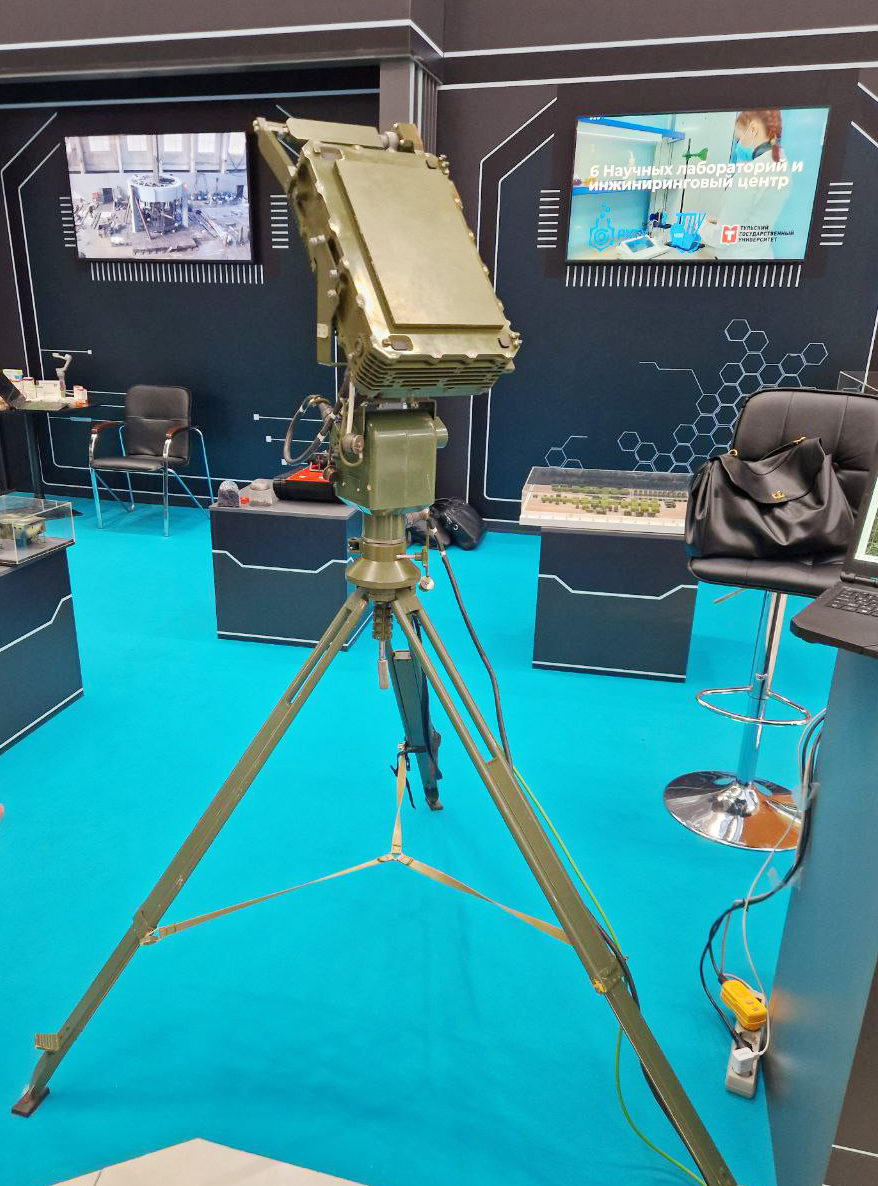
There are military devices on the stands as well. NPO Strela PJSC presented the Sokol portable radar station for detecting mini- and even micro-UAVs. Its difference from its analogs is that it operates on the basis of digital rather than analog technology.
- This is a station for detecting small-sized low-flying aerial targets. It uses a digital phased antenna array. It does not use an analog signal, but its digital processing. The device can see mini-UAVs at a distance of up to 5 km, and micro-UAVs at a distance of up to 2 km. It is much more accurate than the previous generation of stations. This is our prototype, and we have already conducted tests at several military ranges. In a year we plan to start mass production," Yuri Kovalev, a leading engineer of the company, told Izvestia.

There is also a variant of the station to search for ground targets. For example, it can detect a tank at a distance of up to 20 km, and a single person - up to 7 km, the specialist added.
National development goals
On November 28, the main plenary session of CMU 2024 was held on the theme "Science for technological leadership and response to global challenges: people, ideas, cooperation". It was moderated by Deputy Prime Minister Dmitry Chernyshenko. The event began with the Assistant to the President Andrei Fursenko reading from the stage the greeting of the head of state to the participants of the Congress. Then the winners of the BRICS Young Innovators Contest were awarded. The winners were researchers from Russia, China and Brazil.
The conversation was devoted to how to achieve national development goals in the scientific sphere and what strategy successful young scientists choose in their activities.
- This is the fourth time Sirius has welcomed scientists, experts and business representatives to the same venue. Last year's congress was a record in terms of the number of events and the number of participants. But now the scale of the event continues to grow. This is due to the fact that in 2022 the President announced the Decade of Science and Technology. The scientific field is becoming more and more popular. It is in the public eye. And more and more guys connect their lives with Russian science, - said Dmitry Chernyshenko.

Deputy Prime Minister of the Russian Federation Dmitry Chernyshenko
According to sociological surveys, three quarters of parents in our country want their children to build a career in the development of new technologies, and the profession of scientist is considered prestigious by 61% of Russians, emphasized Deputy Prime Minister.

According to Maxim Nikitin, a 38-year-old doctor of sciences, head of the laboratory of nano- and biotechnologies at MIPT, the Congress of Young Scientists is very different from most other scientific events.
- It's a cool platform where most of the scientific community gathers, which gives you the opportunity to communicate with almost everyone in three days.It helps scientific collaborations, scientists are actively looking for the right equipment here, and the sessions allow you to think and fantasize about something new. This does not happen at regular conferences," said Maxim Nikitin.
As part of the "Our Lab" project, the scientist presented his unique development at CMU - a super-sensitive camera capable of catching single photons. According to the creator, this is the world's best sample in its niche.
How to talk about science in an interesting way
As part of the CMU cultural program, the Foundation for Development of Scientific and Cultural Relations "Vyzov", which aims to popularize science and technological achievements, presented the project "Einstein's Lamp".
- Science is very interesting, but at the same time very difficult: a lot of terms, complex theories. How to tell about science in a bright, fascinating and at the same time understandable way? We need to look for unexpected approaches and new formats. All our main projects are based on the relationship between science and art. In the project "Einstein's Lamp" we tried to combine current news from the world of science, humor and even music. It turned out to be unusual, but definitely not boring, - said the President of the Foundation Leonid Shlyakhover.
Participants of the session "Media field is given to entertainment. Is there a chance for intelligence?" discussed whether quality popular science and educational content can compete with entertainment content and what it should be to attract the attention of the audience. According to Alexei Fedorko, Development Director of NMG Doc, the most important thing is that it should touch on topics that are important for everyone.
- Any story of a scientist is not just a life in the laboratory. It is passion and it is destiny. What Mendeleev or Columbus did, for example, and the way they did it, can be packaged into a suspenseful detective or thriller. At the same time, a modern documentary should be high-tech, because people are used to "tick-tocks". We need to use computer graphics. And at the expense of AI to revitalize, for example, old photographs, or to animate historical chronicles, as we have in our projects, - he said.

At the same time, the character itself should be relevant to the present, and his activities should rhyme with our days, added Alexey Fedorko.
The IV Congress of Young Scientists will last until November 29.
Переведено сервисом «Яндекс Переводчик»
